By Marc Jampole
Spring cleaning this year engendered a trip back in time, as I sifted through stacks of obituaries, old articles, papers, letters and photos. Nowadays when something in the media strikes my imagination or ignites my ire, I simply whip off a blog entry. But for years I would cut out the article, jot down some notes and let it molder in a file cabinet.
While mostly tossing out drawers full of yellowed newsprint the other day, I saved a few items that I thought were indicative of trends that I write about today. Consider it this week’s Show and Tell.
Let’s start with an example of corporate misspeak from what was likely the late ‘70s. (I don’t have the exact date because sloppy scholar that I was, I often forgot to date the cut-outs. But it comes from the San Francisco Chronicle and I lived in the Bay Area from 1977-1983, plus the topics on the other side of the page cry out “late '70s.”)
The speaker was James Mack, who at the time was a spokesperson for the National Candy Wholesalers Association. The venue was a hearing about junk food vending machines in public schools held by the U.S. Department of Agriculture (USDA).
At the hearing, Mack claimed that a candy vending machine in schools provides children “with an island of pleasure that is similar to athletics and keeps children from other evils such as alcohol.”
Mack went on to say that banning candy sales in schools could lead to drug abuse and drinking.
Now that’s a man with no shame.
In case you thought that the USDA had more of a spine in those days than it does today, consider that the hearing concerned whether it had the authority to restrict sales of candy, soda pop and chewing gum in schools that receive federally financed lunch programs. Anyone who spent time in public schools in the ‘80s, ‘90s and well into the 21st century knows the candymen, sodapopmeisters and other processed food manufacturers won that one.
Now to a 1978 SF Chronicle article on “The Circle of Gold,” a chain letter infused with spirituality and love, and often distributed at parties attended by as many as 700 people in which the discussion centered on “feeling the energy.” Here’s the catch. With the “Circle of Gold” letter to the person at the top of the list, people were attaching $100 (which today would have the purchasing power of $250), with the hope that by spreading the energy, love, vibes and spiritual feel-goodies, hundreds of thousands of dollars would eventually come back in other circle of Gold letters.
Here is what I wrote in a note about this illegal Ponzi-like scheme in 1978: “The ‘Chain of Gold’ demonstrates that all our values—spiritual, social, moral—are reduced to money in this society.” I was only half right at the time. In fact, only objects and actions (AKA products and services) are reduced to money. Our values, relationships and other spiritual and emotional components of existence are reduced to commercial transactions, i.e., the exchange of money for goods and services. In this sense, the Circle of Gold is a late ‘70s reduction of the ideology of consumerism to its bare essentials—the purchase and exchange involved neither product nor service; nothing but the love and spirituality inherent in cold cash.
Finally, let’s fast forward to the late ‘90s for a great example of making an ideological message without using words: It’s a Parade Magazine photo of Hillary Clinton, then first lady, with her arms around two children, a white boy and an African-American girl.
The white boy stands erectly at attention with a grimly proud expression and is staring intensely at an American flag, as is Hillary. He reaches all the way up to Hillary’s shoulder.
The African-American girl, pig-tailed and in a cute dress, huddles close to Hillary, nestled just below the first lady’s protecting bosom. The girl is looking half at the flag and half at the first lady. The girl’s expression is one of relief, as if she had just been rescued from something bad.
The racist and sexist symbolism of the photo is both obvious and appalling: the white looks to protect the flag, the African-American looks to a government representative for protection. Furthermore, the protector is a male, the protected a female.
The caption is descriptively dispassionate: “Hillary Rodham Clinton takes Brianna Randall, 6, and Aaron Daugherty, 10, through the Blue Room on a tour of the White House. During the peak tourist seasons, about 30,000 visitors a week walk through the main floor.”
Yes, the caption is harmless enough, but the picture tells a thousand words, all lies and myths. When Hillary approved this photo from the ones the photographer presented her, it was not her finest moment.

Wednesday, April 18, 2012
Tuesday, April 17, 2012
Obamacare (What's Not to Like?)
An infographic illustrating public attitudes toward the Patient Protection and Affordable Care Act (a.k.a. "Obamacare")

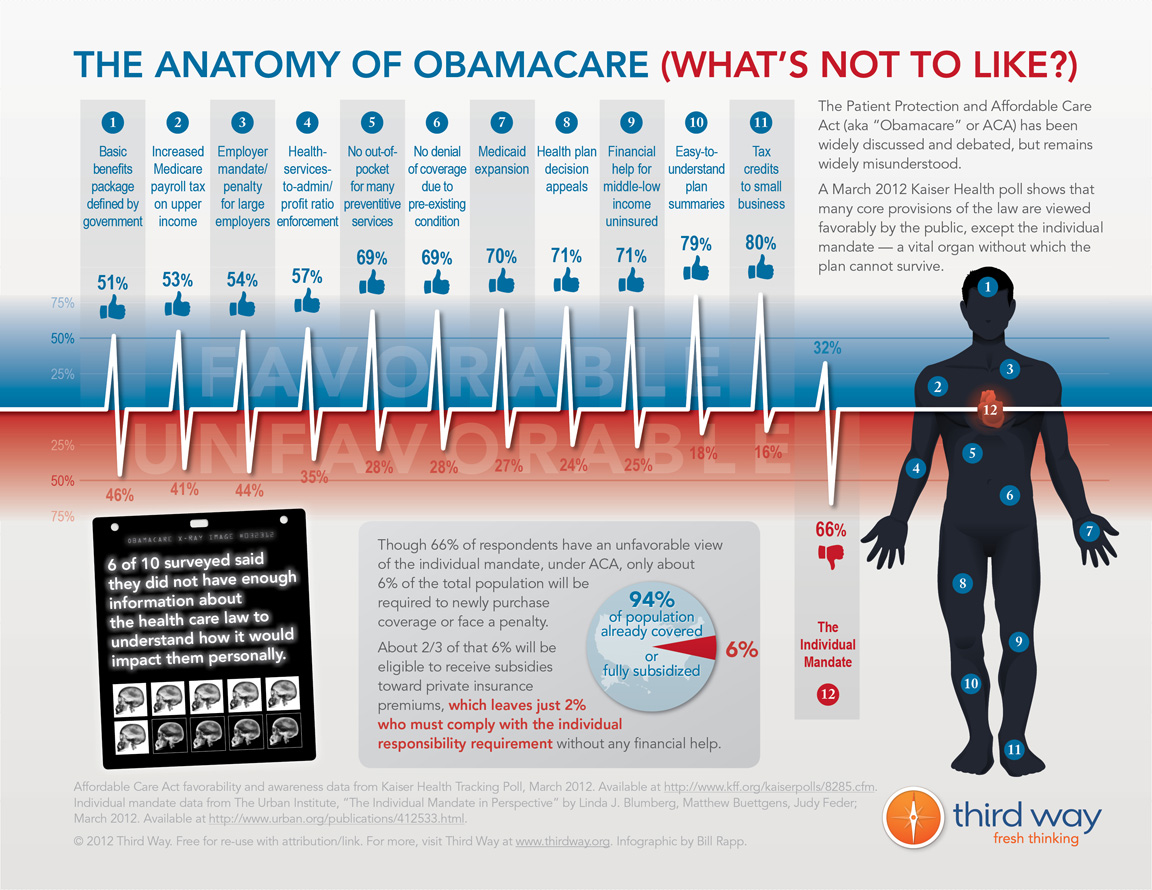
Click on illustration to see it full-sized.
Thanks to Third Way.


Has extensive coverage of comment about Ann Romney made her a symbol for women?
The news media insists on extending the flap about Hillary Rosen’s comment that Ann Romney can’t understand the economy and the struggles of most women because Ann has "never worked a day in her life.” On National Public Radio this morning, Cokie Roberts said that Rosen handed the Romney campaign a gift.
It’s this kind of nonsense that debases political elections. Rosen never should have made the comment but Rosen is a minor player at best and so it never should have become a major story. To think of it as a “gift to Romney” only makes sense if voters are judging the candidates on the off-hand remarks made by minor factotums in the candidate’s party or on the image and track record of their spouses. There is a lot of evidence to suggest that the media wants us to decide elections on these ridiculous factors, at least based on the coverage they give to these flaps as opposed to real discussions of the issues.
One interesting result of this much ado about nothing is that suddenly, Ann Romney has become a symbol of the stay-at-home mom, a dwindling group and one with twice the rate of poverty as moms who work. The latest study I could find (published in 2009) says that only 24% of mothers in families with children under 15 years of age don’t have jobs. And stay-at-home moms tend to be poorer: Just 5.1 %of working moms were below poverty level, while 12.3 % of stay-at-home moms fell into that category.
A few OpEdge readers have insisted in tweets that just because Ann Romney has servants and lived a life of ease does not mean she cannot understand or empathize with the average woman, struggling to make ends meet with or without a job.
Why don’t we begin by considering the question on a theoretical basis: Do you need to have experienced poverty (or racism, the stress of warfare, starvation or other emotional or physical pains) to understand intellectually or feel emotionally the various types of pain felt by those who have experienced these degradations? I used to think one could until I listened to women and African-Americans talking about their feelings of distrust, oppression, lack of confidence, need to prove oneself, or their depictions of barriers that I never saw, but which their fervor and accuracy told me were real. Yes, I understood and sympathized, but I still could not really know their lives and feel their exact feelings.
My experience, however, is anecdotal. I wouldn’t deny anyone else their belief in true empathy towards others with whom one doesn’t have much in common except basic humanity. I yield on the theory.
But let’s forget about the argument over whether or not you can feel another feller’s pain until you walk a mile in his shoes and cut to the chase: The fact that Ann Romney supports her husband’s policies, which cut programs that help poor and working families to fund continued low taxation rates for the wealthy, may not answer the theoretical question about empathy, but it does tell us how much empathy the Romneys, Ann and Mitt, have for the average woman. Zero.
It’s this kind of nonsense that debases political elections. Rosen never should have made the comment but Rosen is a minor player at best and so it never should have become a major story. To think of it as a “gift to Romney” only makes sense if voters are judging the candidates on the off-hand remarks made by minor factotums in the candidate’s party or on the image and track record of their spouses. There is a lot of evidence to suggest that the media wants us to decide elections on these ridiculous factors, at least based on the coverage they give to these flaps as opposed to real discussions of the issues.
One interesting result of this much ado about nothing is that suddenly, Ann Romney has become a symbol of the stay-at-home mom, a dwindling group and one with twice the rate of poverty as moms who work. The latest study I could find (published in 2009) says that only 24% of mothers in families with children under 15 years of age don’t have jobs. And stay-at-home moms tend to be poorer: Just 5.1 %of working moms were below poverty level, while 12.3 % of stay-at-home moms fell into that category.
A few OpEdge readers have insisted in tweets that just because Ann Romney has servants and lived a life of ease does not mean she cannot understand or empathize with the average woman, struggling to make ends meet with or without a job.
Why don’t we begin by considering the question on a theoretical basis: Do you need to have experienced poverty (or racism, the stress of warfare, starvation or other emotional or physical pains) to understand intellectually or feel emotionally the various types of pain felt by those who have experienced these degradations? I used to think one could until I listened to women and African-Americans talking about their feelings of distrust, oppression, lack of confidence, need to prove oneself, or their depictions of barriers that I never saw, but which their fervor and accuracy told me were real. Yes, I understood and sympathized, but I still could not really know their lives and feel their exact feelings.
My experience, however, is anecdotal. I wouldn’t deny anyone else their belief in true empathy towards others with whom one doesn’t have much in common except basic humanity. I yield on the theory.
But let’s forget about the argument over whether or not you can feel another feller’s pain until you walk a mile in his shoes and cut to the chase: The fact that Ann Romney supports her husband’s policies, which cut programs that help poor and working families to fund continued low taxation rates for the wealthy, may not answer the theoretical question about empathy, but it does tell us how much empathy the Romneys, Ann and Mitt, have for the average woman. Zero.
Sunday, April 15, 2012
Selections from the May 1, 2012 issue
COVER/Will Doig
When cities run dry
EDITORIAL
Austerity stalls recovery
RURAL ROUTES/Margot McMillen
Buy food from your neighbors
DISPATCHES
‘Welfare reform’ leaves poor independent, hungry;
Texas saves money on disabled kids;
Hits and misses at Current TV;
26 major corporations paid no taxes;
Grassley: Obama ‘stupid’ for agreeing with Grassley about activist judges;
GAO disputes Christies Hudson Tunnel cost claims;
Wingers hawking Lugar;
GOP still has Social Security 'fix' in mind;
GOP leader's money targets Republicans;
Journos won't call Romney on lies;
Michigan GOP takes voter suppression to next level;
Con group caught lying, repeats lie;
Castro praise sidelines baseball manager ...
MARK ANDERSON
Organic farmers see Monsanto in court
DON ROLLINS
Indy pol: Girl Scouts admire commies
SETH SANDRONSKY
Cal State faculty votes to strike
JIM VAN DER POL
Rural progressives foster healthy conservatism
SAM URETSKY
Conservatives have a mind of their own
HEALTH CARE/Joan Retsinas
The people vs. Obamacare
JOHN BUELL
Europe, US weigh austerity’s science, ethics
WAYNE O’LEARY
Vive la différence
GRASSROOTS/Hank Kalet
Strip-search ruling highlights judicial stakes
BOB BURNETT
Box office supports political ‘Hunger Games’
ROB PATTERSON
Political news seems like unreality TV
Friday, April 13, 2012
Whether Ann Romney understands plight of average woman depends on if she has cook or personal assistant
By Marc Jampole
The news media immediately jumped on Democratic factotum Hillary Rosen when she accused Ann Romney, wife of the presumed Republican presidential nominee, of being unqualified to speak about the economy and the struggles of most women because Ann has ”never worked a day in her life.”
Many have taken the remark to be a slur on housewives who don’t work outside of the home. Suddenly the question of Ann Romney’s competence to speak about economic matters has morphed into an insult to stay-at-home moms. Even President Obama and Vice President Biden defended Ann Romney and by inference those women who, for whatever reason, do not hold a paying job.
But I think that everyone missed the point, because Rosen used the word “work” ambiguously. I don’t think Rosen meant that Ann Romney has never held down a job, but that she has literally never worked, at least not since marrying her robber-baron-turned-hypocrite hubby.
The crux of my argument (and what I think Rosen was really trying to say) depends on yes answers to at least several of the following questions.
The news media immediately jumped on Democratic factotum Hillary Rosen when she accused Ann Romney, wife of the presumed Republican presidential nominee, of being unqualified to speak about the economy and the struggles of most women because Ann has ”never worked a day in her life.”
Many have taken the remark to be a slur on housewives who don’t work outside of the home. Suddenly the question of Ann Romney’s competence to speak about economic matters has morphed into an insult to stay-at-home moms. Even President Obama and Vice President Biden defended Ann Romney and by inference those women who, for whatever reason, do not hold a paying job.
But I think that everyone missed the point, because Rosen used the word “work” ambiguously. I don’t think Rosen meant that Ann Romney has never held down a job, but that she has literally never worked, at least not since marrying her robber-baron-turned-hypocrite hubby.
The crux of my argument (and what I think Rosen was really trying to say) depends on yes answers to at least several of the following questions.
- Does Ann Romney, owner of several houses in various places, have a cook?
- Does she have a housekeeper or cleaning service working more than 16 hours a week in one or more of her homes?
- A driver?
- A personal assistant?
- Someone who routinely is paid to do the food shopping? A gardener or landscape service that works on any one of her properties more than a couple hours a week?
I’m guessing that the answer to all of these questions is yes.
Virtually all women in the United States work very hard. Household chores, shopping and most of the non-fun part of child-rearing fall on the shoulders of the stay-at-home housewife. Women who have jobs typically do more of the housework and childrearing tasks than their spouses, and usually it’s a lot more.
If empathy only comes from experience then Ann Romney definitely cannot relate to most women, be they stay-at-homers, careerists or those burdened with dual responsibilities. Her actually experience in the work force is next to nil and I’m reasonably confident that she has even less experience scrubbing floors and toilet bowls.
But we’re not being given the choice of voting for Ann Romney. It’s her husband not Ann who is running for office. It is true that we have had a run of accomplished first ladies with fine careers beginning with a slightly more famous Hillary and including librarian Laura Bush and attorney Michelle Obama. But we’ve also has housewives who have made perfectly fine first ladies, including the wonderful Betty Ford, who did work before her marriage to Gerry. There is no law that says a first lady has to have had a career or currently have one.
Here’s some advice to voters that often gets lost in the avalanche of non-news stories revolving around personalities, petty spats, verbal blunders and he-said-she saids: Don’t vote for either candidate because you like their spouse or dislike the other’s spouse. Vote for the candidate on the stands he (and maybe someday she) takes and his/her fast track record.
Wednesday, April 11, 2012
Does making making list of Top 10 growth cities indicate vitality or regressiveness?
By Marc Jampole
Earlier this week, CNN Money published a list of the 10 cities in the United States that achieved the greatest population growth from 2000 to 2010.
I’ll save you the trouble of clicking through all 10 web pages to see all the top-growing cities by telescoping it to a single quarter page:
Earlier this week, CNN Money published a list of the 10 cities in the United States that achieved the greatest population growth from 2000 to 2010.
I’ll save you the trouble of clicking through all 10 web pages to see all the top-growing cities by telescoping it to a single quarter page:
- Charlotte, NC
- Raleigh, NC
- Cape Coral, FL
- Provo, UT
- Austin, TX
- Las Vegas, NV
- McAllen, TX
- Knoxville, TN
- Greenville, SC
- San Antonio, TX
The first thing we note is that all of these cities are in the South and Southwest, where much of U.S. population growth has been over the past two decades. That besides population growth, being in these states means that these cities have:
- Lower wages for most people than in the North, Midwest and Far West
- Anti-union laws for decades (except Nevada)
- Less extensive social nets for the poor, young, ill and elderly.
Politically these cities are all located in red states, although North Carolina and Nevada are in the process of moving towards the Democrats. Eight of the 10 cities were part of the United States in 1861, and all 8 of these joined the oppressive slave-owning Confederate States of America.
Before giving right-wingers the chance to say that this growth demonstrates that the conservative mix of free market economics and authoritarian social values works, let me point out a few things:
- These states all receive more in federal funds and benefits than they pay in all federal taxes. From the time of the Roman Republic through the medieval French fairs and until today, places thrive when governments give them money.
- The low-wage jobs that attracted people to most of these places took away other jobs which paid higher wages in other parts of the country which have better social service networks and more public services places. (Note that government and universities played the major role in Austin and Raleigh, while Las Vegas is in sui generis, its own thing).
- These cities are all new and in parts of the country that resisted urbanization longer than the Northeast and Midwest. Newer cities grow faster than mature cities. By definition, regions undergoing urbanization send more people to the cities than regions that have already been urbanized.
I like Raleigh a little, and I’m told that I would enjoy Austin as I do Eugene, Madison, Ithaca and other university towns. But on the whole, this list symbolizes what’s wrong with America today. As a group, these cities are centered on malls that look like each other filled with stores that look each other. These cities are built for cars and not for pedestrians or mass transit. The cities all look more like suburbs than traditional pedestrian-filled, urban mixed use spaces. The states containing these cities have higher rates of poverty and infant mortality and lower rates of people with health insurance. The wages are too low for many workers and less money is spent on providing social services, public education and public spaces than in other states.
And then there’s Las Vegas.
Growth is not always good. Cancer is also a growth.
Since World War II a slow-growing cancer has been poisoning the United States: the car-and mall-centric suburban consumer lifestyle; this wasteful lifestyle in which every celebration, emotional response or other manifestation of a mental state consists of buying something, usually by first getting in your car and driving somewhere. For the same standard of living, we use many times more energy and other natural resources than Western Europeans and the Japanese. These top 10 growth cities all symbolize the reason why the United States is the major contributor to global warming and resource shortages.
These cities represent the growth of sprawl. I would feel much better about the future of the country and the world if at least a few of America’s fastest growing cities were of the traditional type, with great mass transit, beautiful urban parks, lots of interesting local stores, major museums and other arts institutions, many walkers during all times of day and lots of public spaces.
Monday, April 9, 2012
Sunday NY Times loaded with articles that communicate hidden ideology to an unsuspecting public
By Marc Jampole
You ever wonder why Americans so easily follow our leaders into stupid wars or believe such nonsense as it’s uncool to do well in school or be smart?
It’s because hidden in the subtext of what we read, hear and see are a group of ideological assumptions that define how we live and think. The mass media spoon little messages into the hash of information and entertainment they feed us every day. These messages tell us what to believe or assume that we all believe the same thing:
The free market is best. Private sector solutions are always better than government solutions. All human relationships can be expressed and reduced to buying things. Society is best when we all act in our own self interest and not for the good of the whole. Learning and intellectualism are unappealing in both men and women. The United States is an exceptional country iwth a special role to lead the world.
We’re hammered with these false ideas day after day, and sometimes we don’t even know it.
Ideological subtext infects breaking news stories, but it drives feature news media, such as celebrity news, business, book reviews, entertainment and sports. Today’s New York Times shows two well-worn but contrasting ways to imbed ideology into feature articles.
In his weekly chess article, Dylan Loeb McClain reports on a Canadian TV show, “Endgame,” about a former world chess champion who never leaves his luxury hotel suite because he suffers from agoraphobia, which means he is afraid to be in wide-open spaces, crowds, and uncontrollable social situations such as shopping malls, airports, and on bridges.
Here we go again: a genius with severe emotional or relationship problems, unable to adjust, weird, unappealing, a nerd!!!
McClain, who has been doing a good job of telling the public about an exciting new generation of chess players like Hikaru Nakamura and Fabiano Caruana, did not have to do a story on this foreign TV show, which was never popular and was cancelled after one season. He chose to do the story, which means that he chose to perpetuate the myth that chess players are strange beasts.
Yes, Bobby Fischer, probably the greatest chess player of all time, was a nutcase. But Lasker, Euwe, Botvinnik, Karpov, Kasparov and most other world champs have been pretty normal people. I have hung around chess circles all my life and known hundreds of chess players. And some of them have been socially or emotionally off-balanced. Yet, it’s about the same as the percentage of nuts whom I have encountered among Scrabble players, poets, baseball and softball players, public relations professionals and boards of synagogues, social service agencies and other charitable organizations.
McClain’s completely nonjudgmental article focuses on how “Endgame” tries to get the chess right. But as a promoter of chess, McClain should care more about getting the image of chess right. Based on knowing hundreds of chess players, here’s the accurate image of the typical great chess player: a young man who does well in school, is a great athlete and has lots of friends of both sexes. That describes about 15 of the top 18-20 teenage chess players in the Pittsburgh area when my son was playing.
What we have then is one of the most important promoters of the game most associated with intelligence and intellectualism accepting as a given the premise that chess players are weird.
Now let’s turn to one of the cover stories of today's Book Review in which Jonathan Freedland proves once again that the Times book section is always interested in airing the full spectrum of opinion from right-of-center to right-of-center.
Freedland reviews new books on contemporary American geopolitics by Jimmy Carter’s national security advisor Zbigniew Brzezinski and policy wonk Robert Kagan. The premise of the review, as lifted in a quote made large in the wide outside margin of the page, is that “Brzezinski from the left and Kagan from the right agree that America should remain dominant.”
The first distortion is to label Brzezinski as a leftist. When he first appeared in the public imagination in the mid-70’s, it was as a centrist wanting to continue to normalize relations with China and the Soviet Union and interested in pursuing the business interests of large U.S. based multinational corporations. His views on Israel and the Middle East seem right of center to me. Kagan’s own views, as expressed in his new book, have been endorsed by President Obama, the avatar of right-of-center internationalism. Kagan may be to the right of Brzezinski but only by a hair or two.
After setting up the false dichotomy between left and right by portraying one center-rightist as a leftist and another as a rightist, Freedland expresses surprise to learn how much they agree with each other, especially on what matters.” Of course they agree with each other. They both belong in the Jack Kennedy-Scoop Jackson-Richard Nixon-Bill Clinton school of right-looking centrists on international matters.
This school, and American government officials and policy wonks in general, always feel the need to justify American imperial power plays abroad by placing the United States on the twin moral pedestals of pursuing democracy and free market capitalism. No wonder, then, that Kagan is able to write that “The two authors agree that it’s in everyone’s interest, not just America’s, for the United States to remain dominant.”
These two distinguished authors may say it and Kagan may repeat it, but it’s little more than a pretty fiction that our leaders have been telling us, and themselves, for decades. I’m not questioning the need for the United States to remain dominant for the benefit of U.S. multinationals and their political and academic factotums to thrive. And with economic and military dominance, it will be easier for these ruling elites to keep most of the rest of us satisfied with the crumbs from their tables.
What I object to is the false statement that U.S. dominance will be good for the rest of the world. It’s self-serving jingoism, and it’s based on the ideology of American exceptionalism. Like McClain’s covert (and perhaps unknowing) advocacy of anti-intellectualism, Freedland embeds the ideology of exceptionalism into his article by accepting it as an undeniable premise.
You ever wonder why Americans so easily follow our leaders into stupid wars or believe such nonsense as it’s uncool to do well in school or be smart?
It’s because hidden in the subtext of what we read, hear and see are a group of ideological assumptions that define how we live and think. The mass media spoon little messages into the hash of information and entertainment they feed us every day. These messages tell us what to believe or assume that we all believe the same thing:
The free market is best. Private sector solutions are always better than government solutions. All human relationships can be expressed and reduced to buying things. Society is best when we all act in our own self interest and not for the good of the whole. Learning and intellectualism are unappealing in both men and women. The United States is an exceptional country iwth a special role to lead the world.
We’re hammered with these false ideas day after day, and sometimes we don’t even know it.
Ideological subtext infects breaking news stories, but it drives feature news media, such as celebrity news, business, book reviews, entertainment and sports. Today’s New York Times shows two well-worn but contrasting ways to imbed ideology into feature articles.
In his weekly chess article, Dylan Loeb McClain reports on a Canadian TV show, “Endgame,” about a former world chess champion who never leaves his luxury hotel suite because he suffers from agoraphobia, which means he is afraid to be in wide-open spaces, crowds, and uncontrollable social situations such as shopping malls, airports, and on bridges.
Here we go again: a genius with severe emotional or relationship problems, unable to adjust, weird, unappealing, a nerd!!!
McClain, who has been doing a good job of telling the public about an exciting new generation of chess players like Hikaru Nakamura and Fabiano Caruana, did not have to do a story on this foreign TV show, which was never popular and was cancelled after one season. He chose to do the story, which means that he chose to perpetuate the myth that chess players are strange beasts.
Yes, Bobby Fischer, probably the greatest chess player of all time, was a nutcase. But Lasker, Euwe, Botvinnik, Karpov, Kasparov and most other world champs have been pretty normal people. I have hung around chess circles all my life and known hundreds of chess players. And some of them have been socially or emotionally off-balanced. Yet, it’s about the same as the percentage of nuts whom I have encountered among Scrabble players, poets, baseball and softball players, public relations professionals and boards of synagogues, social service agencies and other charitable organizations.
McClain’s completely nonjudgmental article focuses on how “Endgame” tries to get the chess right. But as a promoter of chess, McClain should care more about getting the image of chess right. Based on knowing hundreds of chess players, here’s the accurate image of the typical great chess player: a young man who does well in school, is a great athlete and has lots of friends of both sexes. That describes about 15 of the top 18-20 teenage chess players in the Pittsburgh area when my son was playing.
What we have then is one of the most important promoters of the game most associated with intelligence and intellectualism accepting as a given the premise that chess players are weird.
Now let’s turn to one of the cover stories of today's Book Review in which Jonathan Freedland proves once again that the Times book section is always interested in airing the full spectrum of opinion from right-of-center to right-of-center.
Freedland reviews new books on contemporary American geopolitics by Jimmy Carter’s national security advisor Zbigniew Brzezinski and policy wonk Robert Kagan. The premise of the review, as lifted in a quote made large in the wide outside margin of the page, is that “Brzezinski from the left and Kagan from the right agree that America should remain dominant.”
The first distortion is to label Brzezinski as a leftist. When he first appeared in the public imagination in the mid-70’s, it was as a centrist wanting to continue to normalize relations with China and the Soviet Union and interested in pursuing the business interests of large U.S. based multinational corporations. His views on Israel and the Middle East seem right of center to me. Kagan’s own views, as expressed in his new book, have been endorsed by President Obama, the avatar of right-of-center internationalism. Kagan may be to the right of Brzezinski but only by a hair or two.
After setting up the false dichotomy between left and right by portraying one center-rightist as a leftist and another as a rightist, Freedland expresses surprise to learn how much they agree with each other, especially on what matters.” Of course they agree with each other. They both belong in the Jack Kennedy-Scoop Jackson-Richard Nixon-Bill Clinton school of right-looking centrists on international matters.
This school, and American government officials and policy wonks in general, always feel the need to justify American imperial power plays abroad by placing the United States on the twin moral pedestals of pursuing democracy and free market capitalism. No wonder, then, that Kagan is able to write that “The two authors agree that it’s in everyone’s interest, not just America’s, for the United States to remain dominant.”
These two distinguished authors may say it and Kagan may repeat it, but it’s little more than a pretty fiction that our leaders have been telling us, and themselves, for decades. I’m not questioning the need for the United States to remain dominant for the benefit of U.S. multinationals and their political and academic factotums to thrive. And with economic and military dominance, it will be easier for these ruling elites to keep most of the rest of us satisfied with the crumbs from their tables.
What I object to is the false statement that U.S. dominance will be good for the rest of the world. It’s self-serving jingoism, and it’s based on the ideology of American exceptionalism. Like McClain’s covert (and perhaps unknowing) advocacy of anti-intellectualism, Freedland embeds the ideology of exceptionalism into his article by accepting it as an undeniable premise.
Friday, April 6, 2012
Payoff of fuel efficient cars depends on how you jigger the numbers
By Marc Jampole
Hybrids and other fuel efficient cars tend to cost more than comparable cars without the hybrid battery or other fuel-efficient technology. The natural question from the economic point of view is how long until the breakeven point? How many gallons of gasoline do I have to pump into the hybrid until the cost savings of getting more miles per gallon equals the increased cost to purchase the car?
Nick Bunkley proposed and answered the question for 18 fuel efficient cars in an article titled “Payoff for Efficient Cars Takes Years,” which started on the front page of yesterday’s New York Times business section and continued for almost a full page inside, including chart and photos.
From the Ford Fiesta SFE, which you must run for almost 27 years to break even with the traditional Fiesta to the Jetta TDI, which breaks even in 1.1 years over the traditional Jetta, it takes a while for the money savings to kick in from driving any fuel efficient car, no matter what the technology.
The problem is, Bunkley, like virtually every other economics writer, forgets about a lot of the costs. They only look at the costs that the owner of the car pays directly, and not at the indirect costs that all of society—including the owner—pay, or in this case don’t pay.
These social costs include:
Hybrids and other fuel efficient cars tend to cost more than comparable cars without the hybrid battery or other fuel-efficient technology. The natural question from the economic point of view is how long until the breakeven point? How many gallons of gasoline do I have to pump into the hybrid until the cost savings of getting more miles per gallon equals the increased cost to purchase the car?
Nick Bunkley proposed and answered the question for 18 fuel efficient cars in an article titled “Payoff for Efficient Cars Takes Years,” which started on the front page of yesterday’s New York Times business section and continued for almost a full page inside, including chart and photos.
From the Ford Fiesta SFE, which you must run for almost 27 years to break even with the traditional Fiesta to the Jetta TDI, which breaks even in 1.1 years over the traditional Jetta, it takes a while for the money savings to kick in from driving any fuel efficient car, no matter what the technology.
The problem is, Bunkley, like virtually every other economics writer, forgets about a lot of the costs. They only look at the costs that the owner of the car pays directly, and not at the indirect costs that all of society—including the owner—pay, or in this case don’t pay.
These social costs include:
- The cost of increased respiratory and related illnesses because of the additional pollution.
- The cost in damaged property from the greater increase in extreme weather events that global warming will bring.
- Any costs to remediate the environmental damage directly resulting from car emissions e.g., cleaning buildings and streets.
- The cost of military expenditures to protect gas supplies. Years ago an economist for CNG Pipeline named Mendel Yoho told me that if we added the additional cost of our military expenditures over those of Europe and added that to the price of gasoline that we would be paying about what Europeans pay for their gas.
With the great advances in digital technology and computational software, we can pretty much accurately assess each gallon of gas its share of these social costs. Adding social costs to the current price of gasoline would yield a “real” price of gasoline, which would be much higher, meaning that the payoff of switching to the more fuel efficient car would come more quickly.
We shouldn’t heap too much blame on Mr. Bunkley, who is merely taking a conventional approach.
In general, free-market economists and their popularizers frown upon the concept of social costs. They don’t like the idea of taxing companies and individuals for the social cost of a product or service, for several reasons. On the simplest level, any tax represents constraint on the market. The implication of a tax to assess social costs is that the government is intervening in the economy and society, either by using the money to address the social cost or by redistributing the tax to the population through lower other taxes.
This particular line of reasoning falls within the consistent position of Republicans for decades: no taxes and no redistribution of wealth (which in this case would be from polluters to everyone).
Did Bunkley think about including something about social costs saved by driving fuel-efficient cars and reject the idea? Probably not, because from health care to pollution controls to raising tuition to public universities, economics writings never focus on the cost to society, only to individuals.
And let‘s face it, an article with a list of 36 cars for sale is really about buying stuff. Bunkley is analyzing one of the criteria of purchase. I can imagine the car salesman saying, “The Civic Hybrid may have a cool color and great pick-up, but it’ll take you 12.1 years to break even, while it only takes you 4.4 years if you buy a Lexus HS 250h!”
At the end of the day, whatever one you buy, you’re buying a car, which is about the best thing anyone can do to support our suburbs-and-car-centered consumer society. Never mind that you will pollute the atmosphere to some degree, unless you’re running on solar or wind.
I’d like to see someone do an analysis, with and without social costs, of the breakeven point of building and riding mass transit.
Tuesday, April 3, 2012
A round of wedgies for Supreme Court, pro-gun extremists, Paul Ryan, Rick Santorum and others
Reading the news online this morning made me so angry that I wanted to hurt someone. Actually I wanted to hurt a bunch of people.
But since I’m a left-listing pacifist, I don’t really want to injure anyone or make them experience extreme pain. Maybe just make them feel a little discomfort and a whole lot of shame for what they’ve done.
In other words, I want to give them an OpEdgie Wedgie.
For my readers who may not be familiar with American youth culture or are not native speakers of the American version of English: Merriam-Webster’s defines wedgie as “the condition of having one's clothing wedged between the buttocks usually from having one’s pants or underpants yanked up from behind as a prank.”
Perusing the news about the latest mass murder on a college campus—the killing of 7 at tiny Oikos University in Oakland, California, makes me want to give an OpEdgie Wedgie to anyone who has ever voted for or advocated allowing people other than law enforcement officers to carry guns or bullets on college campuses.
And I’d like to give an OpEdgie Wedgie to Supreme Court Justices Roberts, Scalia, Thomas, Alito and Kennedy for voting that officials may strip-search people arrested for any offense, however minor, before admitting them to jails even if the officials have no reason to suspect the presence of contraband. My wild-running imagination wants these particular operations to leave an imprint of a swastika or hammer & sickle.
And let’s give an OpEdgie Wedgie to whoever in Obama’s Drug Enforcement Administration was involved in the decision to raid Oaksterdam University, a private school that trains people how to grow, package, retail, cook with and sell medical marijuana. Oaksterdam U. is located in California, where use of medical marijuana is legal. The raid represents the sheer stupidity of our drug laws as they apply to a relatively harmless substance that many people use to alleviate pain, subdue anxiety, counteract the nausea of chemotherapy or fight the effects of glaucoma and multiple sclerosis.
Republican presidential candidate Rick Santorum deserves an OpEdgie Wedgie every day, just for being Rick Santorum. He really deserves three or four OpEdgie Wedgies a day, one for his constant use of racial code phrases, one for implying that African-Americans are the primary recipients of government assistance to the poor, one for wanting to inflict his moral values and religious beliefs on the rest of America and one for pretending to advocate for the working class while all along working for the ultra-wealthy.
Mitt Romney deserves a daily OpEdgie Wedgie for hypocrisy and a thirst for power that will make him say or do anything.
And while we’re at it, let’s give a daily dose of the OpEdgie Wedgie to Paul Ryan for saying his budget plan will end the federal deficit by closing tax loopholes, but never telling us which loopholes he will close. For details, see Paul Krugman’s article earlier this week titled "Pink Slime Economics."
Speaking of pink slime, let’s give a pink OpEdgie Wedgie to the manufacturers of this concoction of ground-up meat parts for claiming pink slime is all beef, forgetting to mention that the beef to which they refer includes connective tissue, cartilage and fat. They also forget that it’s not the beef we care about, but the fact that it’s been marinated in ammonia.
I have never gotten or given a wedgie, so until this moment, I never realized what a great release of pent-up aggression one can experience from pulling up someone else’s shorts, even if done only in the head. I feel much better. Relaxed, almost glowing.
All I have to do now is shut the news out and I think I’ll be okay.
But since I’m a left-listing pacifist, I don’t really want to injure anyone or make them experience extreme pain. Maybe just make them feel a little discomfort and a whole lot of shame for what they’ve done.
In other words, I want to give them an OpEdgie Wedgie.
For my readers who may not be familiar with American youth culture or are not native speakers of the American version of English: Merriam-Webster’s defines wedgie as “the condition of having one's clothing wedged between the buttocks usually from having one’s pants or underpants yanked up from behind as a prank.”
Perusing the news about the latest mass murder on a college campus—the killing of 7 at tiny Oikos University in Oakland, California, makes me want to give an OpEdgie Wedgie to anyone who has ever voted for or advocated allowing people other than law enforcement officers to carry guns or bullets on college campuses.
And I’d like to give an OpEdgie Wedgie to Supreme Court Justices Roberts, Scalia, Thomas, Alito and Kennedy for voting that officials may strip-search people arrested for any offense, however minor, before admitting them to jails even if the officials have no reason to suspect the presence of contraband. My wild-running imagination wants these particular operations to leave an imprint of a swastika or hammer & sickle.
And let’s give an OpEdgie Wedgie to whoever in Obama’s Drug Enforcement Administration was involved in the decision to raid Oaksterdam University, a private school that trains people how to grow, package, retail, cook with and sell medical marijuana. Oaksterdam U. is located in California, where use of medical marijuana is legal. The raid represents the sheer stupidity of our drug laws as they apply to a relatively harmless substance that many people use to alleviate pain, subdue anxiety, counteract the nausea of chemotherapy or fight the effects of glaucoma and multiple sclerosis.
Republican presidential candidate Rick Santorum deserves an OpEdgie Wedgie every day, just for being Rick Santorum. He really deserves three or four OpEdgie Wedgies a day, one for his constant use of racial code phrases, one for implying that African-Americans are the primary recipients of government assistance to the poor, one for wanting to inflict his moral values and religious beliefs on the rest of America and one for pretending to advocate for the working class while all along working for the ultra-wealthy.
Mitt Romney deserves a daily OpEdgie Wedgie for hypocrisy and a thirst for power that will make him say or do anything.
And while we’re at it, let’s give a daily dose of the OpEdgie Wedgie to Paul Ryan for saying his budget plan will end the federal deficit by closing tax loopholes, but never telling us which loopholes he will close. For details, see Paul Krugman’s article earlier this week titled "Pink Slime Economics."
Speaking of pink slime, let’s give a pink OpEdgie Wedgie to the manufacturers of this concoction of ground-up meat parts for claiming pink slime is all beef, forgetting to mention that the beef to which they refer includes connective tissue, cartilage and fat. They also forget that it’s not the beef we care about, but the fact that it’s been marinated in ammonia.
I have never gotten or given a wedgie, so until this moment, I never realized what a great release of pent-up aggression one can experience from pulling up someone else’s shorts, even if done only in the head. I feel much better. Relaxed, almost glowing.
All I have to do now is shut the news out and I think I’ll be okay.
Sunday, April 1, 2012


Selections from the April 15, 2012 issue
COVER/Irin Carmon
GOP fights female rights
EDITORIAL
Mandate or Medicare
LETTERS TO THE EDITOR
RURAL ROUTES/Margot McMillen
Morality left out of corporate calculations
DISPATCHES
Dishonoring Trayvon Martin;
Concealed Carry death toll mounts;
Five states debate ‘Stand Your Ground’ laws;
Senate Repubs tease, then block move to end oil subsidies;
Senators who voted to protect oil tax breaks got $23M from Big Oil;
Exxon profits up, taxes down;
Obama orders strong carbon rules;
Five banks control 52% of US assets;
Four voter fraud cases disenfranchise 800,000 Texans;
Voter restrictions block electoral vote;
House Repubs accidentally endorse constitutionality of ACA;
US appeals labeling smackdown;
Public doesn't like GOP Medicare plan;
Obama gets world's vote ...
BOB BURNETT
‘Game Change’ documents GOP ID crisis
MARGIE BURNS
Republicans head for heated convention
DON ROLLINS
GOP rep says no poor folks in N.C.
MARK ANDERSON
Keystone pipeline meets stubborn Texan
BOOK REVIEW/Seth Sandronsky
Looking at a year of revolt in Wisconsin
HEALTH CARE/Joan Retsinas
Medicare on chopping block
SAM URETSKY
Romney and Santorum ridicule college
WAYNE O’LEARY
Not going postal
JOHN BUELL
Politics in these times
GRASSROOTS/Hank Kalet
Energy costs shifted to society
JIM CULLEN
Ten documentaries to look for
ROB PATTERSON
Young people retire in ‘Portlandia’
Thursday, March 29, 2012
Take a look around and everywhere you’ll see the benefits of government to businesses and people
By Marc Jampole
Yesterday I took a local Metro North train from White Plains, where I had been meeting with a client, back to Manhattan, where we’re staying for a few days. The train was crowded and along the way I saw people get on and off, riding from one Westchester County suburb to another. At the Fordham stop in the city, a bunch of college students boarded. I saw many like me carrying briefcases and dressed for the business world. Others were clearly bound for a cultural attraction or to do some shopping.
What I also saw was government providing low-cost transportation to people of all social classes and helping to address both traffic and environmental problems.
Along the way, we went over bridges and saw other bridges, filled with automobiles. We saw roads and when we could see streets, they were mostly clean. Government built those roads and bridges and maintains them.
In the evening, we took the government owned and operated clean and safe subway to Carnegie Hall to see Michael Tilson-Thomas and the San Francisco Symphony do a magnificent concert of 20th century classical music. In the program notes I discovered that Carnegie Hall presents a wide range of music and other cultural activities, something for everyone. The program also lists all the donors that have contributed at least $2,500 in the past year to what is perhaps America’s most famous concert hall. But it also tells us who owns and operates Carnegie Hall. Guess what! It’s the City of New York.
At the concert, we spoke briefly with an older woman whose clothing and jewelry told us that she is fairly well-off. This very pleasant and enthusiastic woman most assuredly receives her medical services at low cost through Medicare. She likely collects Social Security, as well.
Earlier that day I had lunch with a cousin who lives in the tiny Scarsdale suburb about one of her children who has a learning disability. The boy goes to a public school and gets special attention and classes. I also spoke on the phone and made plans to see another cousin, who is a magnificent school librarian, a real pro with a special charisma who knows how to engage children of all levels of development. And yes, she works at a New York City public school. And then I remembered what a great education I received from the New York City schools (until my family left in 10th grade), highlighted by the opportunity to attend Stuyvesant High School, a high school for the gifted with wonderful laboratories and other facilities.
Everywhere I looked I saw government making our lives better: protecting us, keeping our streets maintained and clean, taking us places, educating our children, making it possible for businesses to exist, keeping us healthy, providing a stable retirement program for all workers.
And it’s all threatened by more than 30 years of low taxes and cuts to government services, fueled by the political mentality that I call Reaganism. The two central beliefs of this mentality propose that individuals should only care about their own selfish interests and that the government is always bad (except for fighting wars). This regime of tax cuts that primarily benefit the wealthy and ultra-wealthy and underinvest in our civilization has led to a dire situation:
Yesterday I took a local Metro North train from White Plains, where I had been meeting with a client, back to Manhattan, where we’re staying for a few days. The train was crowded and along the way I saw people get on and off, riding from one Westchester County suburb to another. At the Fordham stop in the city, a bunch of college students boarded. I saw many like me carrying briefcases and dressed for the business world. Others were clearly bound for a cultural attraction or to do some shopping.
What I also saw was government providing low-cost transportation to people of all social classes and helping to address both traffic and environmental problems.
Along the way, we went over bridges and saw other bridges, filled with automobiles. We saw roads and when we could see streets, they were mostly clean. Government built those roads and bridges and maintains them.
In the evening, we took the government owned and operated clean and safe subway to Carnegie Hall to see Michael Tilson-Thomas and the San Francisco Symphony do a magnificent concert of 20th century classical music. In the program notes I discovered that Carnegie Hall presents a wide range of music and other cultural activities, something for everyone. The program also lists all the donors that have contributed at least $2,500 in the past year to what is perhaps America’s most famous concert hall. But it also tells us who owns and operates Carnegie Hall. Guess what! It’s the City of New York.
At the concert, we spoke briefly with an older woman whose clothing and jewelry told us that she is fairly well-off. This very pleasant and enthusiastic woman most assuredly receives her medical services at low cost through Medicare. She likely collects Social Security, as well.
Earlier that day I had lunch with a cousin who lives in the tiny Scarsdale suburb about one of her children who has a learning disability. The boy goes to a public school and gets special attention and classes. I also spoke on the phone and made plans to see another cousin, who is a magnificent school librarian, a real pro with a special charisma who knows how to engage children of all levels of development. And yes, she works at a New York City public school. And then I remembered what a great education I received from the New York City schools (until my family left in 10th grade), highlighted by the opportunity to attend Stuyvesant High School, a high school for the gifted with wonderful laboratories and other facilities.
Everywhere I looked I saw government making our lives better: protecting us, keeping our streets maintained and clean, taking us places, educating our children, making it possible for businesses to exist, keeping us healthy, providing a stable retirement program for all workers.
And it’s all threatened by more than 30 years of low taxes and cuts to government services, fueled by the political mentality that I call Reaganism. The two central beliefs of this mentality propose that individuals should only care about their own selfish interests and that the government is always bad (except for fighting wars). This regime of tax cuts that primarily benefit the wealthy and ultra-wealthy and underinvest in our civilization has led to a dire situation:
- School budgets are being cut in New York and everywhere else. In many schools, art lessons, music education and other non-core classes have been slashed and classes are too large.
- State governments are retreating from their long-term commitment to state supported universities and colleges. In the late 60s and early 70s, my tuition (paid for by a state of Wisconsin “Leadership and Need” scholarship) was $175 a semester to attend the University of Wisconsin-Milwaukee campus and learn from many inspiring scholars such as Davy Carozza, Corliss Philabaum and Ihab Hussan. Enough said there.
- More than 30 years of inadequate investment and maintenance have left our infrastructure of roads and bridges in a sorry state. We’ve seen bridges crumble and potholes seemingly multiply like rabbits. Of course, when we let roads deteriorate because taxes are too low, individuals end up paying more on tires, brakes, gas and realignments.
- In New York, mass transit cuts appear to be an irritant only, but in many other places such as Pittsburgh, transit cuts are hurting many people.
It’s no coincidence that residents of the New York City metropolitan area pay some of the highest tax rates in the country. They enjoy so many services.
Government is not perfect. Government comprises people, and people make mistakes. Large groups are sometimes slow to identify and react to new challenges, which can lead to an inefficient use of funds. Bureaucracies can be infuriating. Leaders can sometimes lead government entities down the wrong path, as with the Bush II wars in Iraq and Afghanistan or Truman’s decision to pursue nuclear-generated electricity instead of solar power in the early 50s.
It sounds just like every company for which I ever worked, all of my clients and my own small business.
And don’t believe the nonsense that raising taxes hurts the economy and leads to layoffs. As the estimable Eduardo Porter pointed out in The New York Times earlier this week, “a growing body of research suggests not only that the government could raise much more revenue by sharply raising the top tax rates paid by the richest Americans, but it could do so without slowing economic growth. Top tax rates could go as high as 80 percent or more.”
So the next time you consider voting for anyone who wants to maintain taxes or lower them still further, look around you and see what government does for you and the community in which you live and the economy that provides your income. Think about how much better things could be if government had the money to improve these services. And remember that the more money you make, the more valuable to you are the government services that make it possible. Now in my mind, when you get more, you pay more.
No class warfare here, just the realization that we’re all in this thing called the United States together and that everyone should give their fair share so that our society and all of us can thrive.
Tuesday, March 27, 2012
Anti-global warming professor may or may not know physics, but he sure knows propaganda
By Marc Jampole
William Happer, a physicist at Princeton who specializes in optics and spectroscopy (study of wavelengths), authored an anti-global warming screed in this morning’s Wall Street Journal which could serve as a primer for propaganda techniques. The article pretends to prove the veracity of its title “Global Warming Models are Wrong Again,” but careful analysis reveals his arguments are built more on rhetorical tricks than on facts.
Whatever the quality of Happer’s scientific research, he is a superb propagandist. But when we pick apart some of the statements and assertions that Happer makes in this hapless article, we find he primarily uses propaganda techniques and not facts or logic to make his case. In the bullets below, Happer’s quotes are in italics:
William Happer, a physicist at Princeton who specializes in optics and spectroscopy (study of wavelengths), authored an anti-global warming screed in this morning’s Wall Street Journal which could serve as a primer for propaganda techniques. The article pretends to prove the veracity of its title “Global Warming Models are Wrong Again,” but careful analysis reveals his arguments are built more on rhetorical tricks than on facts.
Whatever the quality of Happer’s scientific research, he is a superb propagandist. But when we pick apart some of the statements and assertions that Happer makes in this hapless article, we find he primarily uses propaganda techniques and not facts or logic to make his case. In the bullets below, Happer’s quotes are in italics:
- “What is happening to global temperatures in reality? The answer is: almost nothing for more than 10 years.” What Happer does is take a meaningless slice of time for climate change. If he looked at 200 years of data, he would see that the world is getting warmer. Making the last 10 years as the length of time in which to measure global warming uses a technique I call FRAMING, which occurs when you define a problem to get the answer you want.
- “CO2 is not a pollutant. Life on earth flourished for hundreds of millions of years at much higher CO2 levels than we see today. Increasing CO2 levels will be a net benefit because cultivated plants grow better and are more resistant to drought at higher CO2 levels, and because warming and other supposedly harmful effects of CO2 have been greatly exaggerated. Nations with affordable energy from fossil fuels are more prosperous and healthy than those without.” Let’s forget the fact that the life that existed on earth with much higher levels of CO2 than today didn’t include humans or other large mammals. Let’s focus instead on the end of this paragraph, which is a NON SEQUITUR (which loosely means that it makes no sense or that A doesn’t really prove B): Although fossil fuels release CO2, that does not mean that you can disprove the theory that too much CO2 harms the Earth; it only means that cheap energy is necessary for nations to thrive.
- “The direct warming due to doubling CO2 levels in the atmosphere can be calculated to cause a warming of about one degree Celsius. The IPCC computer models predict a much larger warming, three degrees Celsius or even more, because they assume changes in water vapor or clouds that supposedly amplify the direct warming from CO2. Many lines of observational evidence suggest that this "positive feedback" also has been greatly exaggerated.” Note that Happer gives attribution for a computer model that predicts global warming, but does not tell which studies or computer simulations disproves it. He uses the passive construction to AVOID ATTRIBUTION. If he changed the passive “can be calculated to cause…” to an active tense, “XYZ calculates,” grammar would force him to tell us who did the calculations. “Many lines of observational evidence…,” begs the question, “Which lines?” and also avoids telling us who is following, making or observing these “lines.” If you believe in this research, sir, tell us who did it? But if Happer told us who did this so-called research he cites, we might find that it’s shoddy, has already been discounted, makes framing mistakes, was done by non-scientists or isn’t really research. We don’t really know unless Happer offers the citations.
- “But there is no hard evidence this is true. After an unusually cold winter in 2011 (December 2010-February 2011) the winter of 2012 was unusually warm in the continental United States. But the winter of 2012 was bitter in Europe, Asia and Alaska.” Happer is ARGUING BY ANECDOTE. The argument by anecdote provides examples and assumes that we will extrapolate from those examples to the conclusion the writer or speaker wants us to draw. Happer talks about what has happened over the course of two years, when global warming is a process that has occurred over many decades; in this context, two years are only anecdotes, not statistically valid data.
- “Nightly television pictures of the tragic destruction from tornadoes over the past months might make one wonder if the frequency of tornadoes is increasing, perhaps due to the increasing levels of CO2 in the atmosphere. But as one can read at Andrew Revkin's New York Times blog, dotearth, ‘There is no evidence of any trend in the number of potent tornadoes (category F2 and up) over the past 50 years in the United States, even as global temperatures have risen markedly.’” The sentences I quote are the beginning of a multi-paragraph argument in which Happer proves without a doubt that the number of tornadoes have not increased in the United States (he never mentions the rest of the world). He really takes apart those who believe that global warming has led to more tornadoes. But who is saying it? I googled “tornadoes global warming” and could only come up with articles in which experts say that there has not been an increase in tornadoes. I could come up with no article in which a scientist or a group has said that tornadoes have increased (except for a speculating weather personality or two trying to spice up coverage of a tornado). What Happer has done is set up a STRAW MAN, which means he creates an argument which is easy to destroy and then destroys it. And once again, he bases his argument on a NON SEQUITUR. He wants us to believe that just because there has not been an increase in tornadoes that there has been no global warming, nor damage from same. His reasoning is absurd, even if it builds on the idea that global warming will create more extreme weather. Extreme weather includes a lot more than tornadoes. I sense (but don’t know for a fact) that he selects tornadoes to discuss for precisely this reason, another example of FRAMING the argument to get the conclusion you want. Reduced to rhetorical principles, Happer frames the argument, then destroys a straw man, all so he can make a statement that’s a non sequitur.
Happer ends by invoking the sainted Richard Feynman on scientific research in general. He then closes with, “The most important component of climate science is careful, long-term observations of climate-related phenomena, from space, from land, and in the oceans. If observations do not support code predictions—like more extreme weather, or rapidly rising global temperatures—Feynman has told us what conclusions to draw about the theory.” If you only skim these last two paragraphs, you might come to the conclusion that Feynman, one of the most important physicists since Einstein, is against global warming. But all Feynman is saying is that science is based on facts.
Note that in this last paragraph, all Happer is really stating is that we should judge the theory of global warming on facts and if the facts aren’t there, the theory is wrong. His rhetoric avoids a direct statement about global warming. Some might call is a rhetorical flourish: the writer puts down the facts and we make the conclusion, a kind of 1+1=2 (or in the case of the implication that Happer wants us to draw, 1+1=3!).
But I think Happer is using this rhetorical device to avoid speaking directly, because he knows that the facts are against him.
Monday, March 26, 2012
Atheist march reminds that in our secular society there shouldn’t be polarization between believers and nonbelievers
By Marc Jampole
Yesterday’s rally of atheists, agnostics and others who don’t believe in religion had a flavor of liberation politics. The tone of the language reported across the country and around the world resembled the kind of pleas for recognition that people of color, gays, women, Hispanics, people with disabilities, Moslems and other groups seeking their rights in society have issued through the years.
Sample these comments by speakers:
Yesterday’s rally of atheists, agnostics and others who don’t believe in religion had a flavor of liberation politics. The tone of the language reported across the country and around the world resembled the kind of pleas for recognition that people of color, gays, women, Hispanics, people with disabilities, Moslems and other groups seeking their rights in society have issued through the years.
Sample these comments by speakers:
- “There are too many people in this country who have been cowed into fear of coming out as atheists, secularists or agnostics,” said Richard Dawkins, the British scientist whose ventures into pop science have unfortunately led to his misleading anthropomorphizing of chemicals in the body (i.e., he attributes emotions and goals to genetic material).
- “These are battles that homosexuals have won, people of color have won, women have won,” said Jamila Bey, who claims to have once lost a job when her boss learned she was an atheist.
- “We have the numbers to be taken seriously,” said Paul Fidalgo of the Center for Inquiry, which promotes the scientific method and reasoning and helped organize the rally.
- “Coming here makes me feel less alone,” said 13-year-old Catherine Williams, who attends a small conservative private school and is reported to have said that it can be uncomfortable because many of her classmates are vocal about their religious beliefs.
While discrimination against atheists for their beliefs may exist, lumping non-believers together as just another interest group may ultimately have a negative impact on achieving the goals that brought together the 20 groups and 15,000 people who rallied yesterday.
Here’s why: The social right-wing always pose religious issues as a battle between good and evil and the rest of the country hears it as a battle between two competing special interest groups, for example, women versus the Catholic Church. For both the right and the mainstream, religiously-tinged issues—contraception, abortion, gay marriage, crèches in public, religious groups in public schools and the teaching of evolution—are characterized as battles between two sides. Identifying a new special interest group—nonbelievers—intensifies this tendency towards polarization.
And yet the Constitution is clear: there should be an absolute separation of church and state and all individuals should have the right to practice his or her own religion, assuming it doesn’t break the basic laws of the land, e.g., mutilation of children or marrying more than one wife. By presenting themselves as an oppressed group, nonbelievers buy into the “us versus them” mentality created by the opposition of special interests. The media and society then both take it upon themselves to “balance the needs” of the competing groups, when in fact there should not be a competition or a balancing at all, since we are officially a secular country.
In short, by assuming the mantle of a special interest group, nonbelievers turn the story into a battle between atheists and the God-fearing. That plays right into the hands of social conservatives. The issue transforms from right-wingers against the Constitution into believers versus nonbelievers.
Instead of pleading for recognition as a group, the rally should have focused more on the key issues which I believe unite all those who don’t believe in religion:
- National science standards that would insure that we teach science in science classes, while leaving religious theories such as intelligent design for elective comparative religion courses in high school.
- National environmental, energy and other policies that are determined and implemented based on scientific studies.
- Standards of conduct that would ensure that proselytization of one religion never again becomes the unofficial policy of a branch of the armed services as it did to a certain extent in the Air Force for years.
These policy issues, by the way, should unite atheists, agnostics and secularists with most Moslems, Jews, Hindus, Catholics, Buddhists, Taoists, Animists, Pantheists, Wiccans and all brands of Christians. In an open society all religious groups can thrive, as none are either oppressed or treated with any special deference. Let’s focus our efforts on keeping our society as open as it is and opening it more. We don’t do it by conceptualizing oppressed groups. That only helps the right-wing legitimize itself and feeds the news media’s predilection to polarize instead of analyze. Instead, I urge nonbelievers to put their energies into the issues.
I’m not saying that nonbelievers shouldn’t organize, only that they should organize around issues and thus avoid becoming the “counter-balance” to believers.
Thursday, March 22, 2012
Paul Starr’s Remedy and Reaction offers insightful review of the history of U.S. health care reform
By Marc Jampole
With the Supreme Court considering multiple challenges to the constitutionality of the Affordable Care Act of 2010 next week, Progressive Populist readers might want to delve into the long-term history of health care reform in the United States. If so, there is no better place to go than Paul Starr’s recent Remedy and Reaction: The Peculiar Struggle over Health Care Reform, which traces health care reform from the earliest proposals for government-sponsored health insurance just before and during World War I.
Starr is without a doubt the guy to tackle the subject. Since its 1984 publication, his Social Transformation of American Medicine has become established not just as the seminal work in the narrow field of health care, but as one of the very most important books of American social history. Since then, Starr has taught, conducted historical research into both health care and the media and served as a senior health care advisor for Bill Clinton. He is co-editor of The American Prospect.
Here are some of the insights that I gleaned from reading Remedy and Reaction:
A lost golden moment
There was a golden moment when all the stars were aligned for a major overall of the healthcare system which would have ensured that virtually every American had healthcare insurance. Both Republicans and Democrats pretty much agreed on what to do, the various constituencies such as insurers, physicians and the public were either on board or not opposed and the president in charge supported the idea and knew how to get things done. Unfortunately, the president was Richard Nixon and a potentially watershed moment drowned in the Watergate scandal.
Mitt Romney's important role
Starr documents that the Affordable Care Act is profoundly the child of the successful Massachusetts plan that Governor Mitt Romney competently shepherded to passage and then efficiently implemented. The federal plan is derived from the same philosophy and using pretty much the same set of strategies and tactics as the Massachusetts plan. Starr also points out that Romney did not talk about healthcare reform during his gubernatorial campaign, but once in office he rolled up his sleeves and displayed enormous competence. Starr doesn’t say it, but I will: the Romney disavowal of his landmark accomplishment strongly suggests that Mitt is a value-free technocrat whose idea of being in charge is to implement competently the desires of his backers, whatever that means. By repudiating his own good works, Romney transforms himself from a major statesman to the ethical equivalent of an Albert Speer, that wonderfully brilliant architect and thinker who dedicated himself to accomplishing the will of his backers.
Not a socialist plot
Starr shows that the basic philosophy behind Obama’s plan from the beginning has been to cover more people and cut the cost of coverage while taking a pragmatic approach that does not profoundly upset the current complicated system that mixes public and private solutions and funding sources. Its dependence on private insurance and patient cost sharing derive from Republican ideas. So is the idea of not creating a “public option,” but instead establishing insurance exchanges, which are marketplaces for insurance for those not covered by government programs or their employers.
Like all compromises, there is something for everyone to hate and love about the Affordable Care Act. But Starr, who would probably have preferred a more European style system, brings up a stunning fact that should win the day with many centrists and progressives: The impact over Obama’s healthcare reform over 10 years will be to increase total healthcare costs in the United States by a worst-case 1 percent, while providing coverage to 32 million more people, or a little over 10% of the American population. By that math, the cost per person for health care goes down, which means that by applying some quick fixes to the current system, we cover many more people and at a lower cost.
It’s an imperfect law that doesn’t address all the challenges of perfecting an imperfect system, but it is nevertheless landmark legislation. Let’s hope the most right-wing Supreme Court since the Dred Scott days agrees.
With the Supreme Court considering multiple challenges to the constitutionality of the Affordable Care Act of 2010 next week, Progressive Populist readers might want to delve into the long-term history of health care reform in the United States. If so, there is no better place to go than Paul Starr’s recent Remedy and Reaction: The Peculiar Struggle over Health Care Reform, which traces health care reform from the earliest proposals for government-sponsored health insurance just before and during World War I.
Starr is without a doubt the guy to tackle the subject. Since its 1984 publication, his Social Transformation of American Medicine has become established not just as the seminal work in the narrow field of health care, but as one of the very most important books of American social history. Since then, Starr has taught, conducted historical research into both health care and the media and served as a senior health care advisor for Bill Clinton. He is co-editor of The American Prospect.
Here are some of the insights that I gleaned from reading Remedy and Reaction:
A lost golden moment
There was a golden moment when all the stars were aligned for a major overall of the healthcare system which would have ensured that virtually every American had healthcare insurance. Both Republicans and Democrats pretty much agreed on what to do, the various constituencies such as insurers, physicians and the public were either on board or not opposed and the president in charge supported the idea and knew how to get things done. Unfortunately, the president was Richard Nixon and a potentially watershed moment drowned in the Watergate scandal.
Mitt Romney's important role
Starr documents that the Affordable Care Act is profoundly the child of the successful Massachusetts plan that Governor Mitt Romney competently shepherded to passage and then efficiently implemented. The federal plan is derived from the same philosophy and using pretty much the same set of strategies and tactics as the Massachusetts plan. Starr also points out that Romney did not talk about healthcare reform during his gubernatorial campaign, but once in office he rolled up his sleeves and displayed enormous competence. Starr doesn’t say it, but I will: the Romney disavowal of his landmark accomplishment strongly suggests that Mitt is a value-free technocrat whose idea of being in charge is to implement competently the desires of his backers, whatever that means. By repudiating his own good works, Romney transforms himself from a major statesman to the ethical equivalent of an Albert Speer, that wonderfully brilliant architect and thinker who dedicated himself to accomplishing the will of his backers.
Not a socialist plot
Starr shows that the basic philosophy behind Obama’s plan from the beginning has been to cover more people and cut the cost of coverage while taking a pragmatic approach that does not profoundly upset the current complicated system that mixes public and private solutions and funding sources. Its dependence on private insurance and patient cost sharing derive from Republican ideas. So is the idea of not creating a “public option,” but instead establishing insurance exchanges, which are marketplaces for insurance for those not covered by government programs or their employers.
Like all compromises, there is something for everyone to hate and love about the Affordable Care Act. But Starr, who would probably have preferred a more European style system, brings up a stunning fact that should win the day with many centrists and progressives: The impact over Obama’s healthcare reform over 10 years will be to increase total healthcare costs in the United States by a worst-case 1 percent, while providing coverage to 32 million more people, or a little over 10% of the American population. By that math, the cost per person for health care goes down, which means that by applying some quick fixes to the current system, we cover many more people and at a lower cost.
It’s an imperfect law that doesn’t address all the challenges of perfecting an imperfect system, but it is nevertheless landmark legislation. Let’s hope the most right-wing Supreme Court since the Dred Scott days agrees.
Tuesday, March 20, 2012
For Mitt Romney, freedom’s just another word for nothing left to win
The core of Romney’s big speech in Chicago yesterday was his accusation that the Obama Administration has pursued “an assault on freedom” with new business regulations and higher taxes. The expression freedom is bandied about a lot, especially by Republicans bewailing its imminent loss—economic freedom, personal freedom, religious freedom. But what about freedom from breathing dirty air? The freedom from hunger? The freedom from economic insecurity? The freedom from disease?
We can pose both sides of most issues as a test of freedom. In the days of the civil rights movement, it was the freedom to sit in a restaurant versus the freedom to deny service in a business establishment. The current flap about contraception pits the freedom of women versus the freedom of a religion to discriminate against women.
Of course, the more we apply the word “freedom,” the more it loses all meaning. And that’s the point!
The value of any word to a propagandist or ideologue increases as the meaning of the word becomes more amorphous, harder to pin down. And there is no more amorphous word than freedom.
The first definition of freedom in Merriam-Webster’s is “the quality or state of being free: the quality or state of not being coerced or constrained by fate, necessity, or circumstances in one’s choices or actions.” The entry, however, goes on for many paragraphs and gives many different meanings to the word. The synonyms for freedom, some contradictory, suggest how easy it is for propagandists to find a meaning to fit the moment: “self-determination,” “independence,” “liberty,” “facility,” “ease”,” right,” “privilege,” “franchise,” and even “generosity” (which is not the essence of the freedom from taxation that Romney would like America’s wealthiest to continue enjoying). Then there’s Kris Kristofferson’s definition, made famous by Janis Joplin: another word for nothing left to lose.
One anecdote on the use of freedom outside the political realm should illuminate the power of words that lose meaning. A few years ago at a family Bat Mitzvah in California, the rabbi performing the service said in his sermon that “Torah is freedom. The more Torah, the more freedom.”
It was of course, a completely false statement. The Torah, which comprises the first five books of the Jewish Bible, does include many well-loved biblical stories and all of the ones told by Jews, Christians and Moslems alike. But the Torah is primarily a book of laws, 613 to be precise, whose purpose is to restrain the behavior of people, i.e., take away their freedom. Thou shall not kill. Thou shalt not steal. Thou shalt not commit adultery. These are the birds you should regard as unclean. According to the Jewish tradition, the Torah is the source for every Jewish law, even those not mentioned in it. That includes all the laws that take away freedoms related to eating, traveling and mixing the sexes in social situations.
These laws take freedom away from people. The more Torah, the less freedom. And yet so many of the congregants smiled in agreement when the rabbi equated a book of mostly proscriptive laws with freedom.
Whether he knew it or not, the rabbi was using yet another definition of freedom. Freedom is also that feeling of supreme exhilaration and limitless power that people describe as “feeling free.” I remember when I was much younger and religious, I would sometimes read the Torah and get a sudden feeling of being free, like the feeling when I used to take my feet off the pedals and glide my bicycle down a steep hill, or the feeling when I quit one job for another one that paid 36% more. Many TV commercials will say their products help attain this “feeling of freedom.”
From kindergarten on, we are indoctrinated to the importance of freedom and “the feeling of freedom” at school and in the mass media. We are taught that the United States was founded to promote freedom (at the time, of course, only for white adult males who owned property) and that the United States is a beacon of freedom to the world. One of the major themes in our history is the gradual spread of freedom through increased freedom for our citizens and in the foreign lands that the myth says we have saved. We claim that every war we fight is to protect our freedom or the freedom of the people whose land we are invading, or both. Thinking about American freedom can swell the chests of many of us with an almost swooning pride. We have learned to feel the “freedom feeling” whenever we consider our history, culture and laws.
It is this definition of freedom—this feeling—to which Romney appeals when he talks about economic freedom. When he says the policies of his party will increase freedom, he wants people’s hearts to swell with the feeling of freedom and then recoil with the fear at the thought of lost freedom because of environmental regulation, healthcare reform or raising taxes on the wealthy. He never mentions that his tax freedom results in less money for society to help people be free from disease, from ignorance, from hunger, from the helplessness of old age and from the frustration of poverty. He never mentions that his freedom from regulation makes people less free from business scams, unsafe products, dirty air and infectious water.
Many philosophers believe that the essence of civilization is restraint. Learning restraint—limiting your freedom for your future good, the good of others or the common good—is at the heart of the process of growing up from infancy into a mature member of society.
Romney and the rest of the Republicans don’t really want absolute freedom in the economic realm. They just believe that our laws should protect the rights of individuals and organizations to do as they please (outside the sexual realm) as opposed to protecting the rights of people to have the basic human dignities of food, health care, education and the opportunity to make a living and improve their lot. Those who say that unfettered economic freedom enables more people to enjoy all the other freedoms are merely expressing their beliefs, which they constantly and inaccurately present as a fact-based theory. History, however, is filled of examples of how taking away an economic freedom—the freedom to hire children, the freedom to dump toxic chemicals into rivers, the freedom to charge what you like because you have a monopoly, the freedom to pay someone less than minimum wage or the freedom to prevent union organizing—has improved society and helped the economy. It’s one set of rights versus another. We can also call them freedoms, but once we do, the concept of freedom loses its meaning.
In the realm of political campaigning, “freedom” has become something one accuses the opponent of not loving/having/protecting/cherishing. With name-calling, we say, “you’re this,” but freedom in the Republican’s sense is conjured only in its absence as a characteristic. Saying the opponent or the idea is against freedom is a highly sophisticated form of name-calling, dependent not just on conflating different concepts of freedom, but also on a body of unproved assertions and an almost autonomic emotional reaction.
But emotions aside, keep it in mind that when Romney says the election is about freedom, he means the freedom of the economic and social class he represents to continue pulling more and more wealth from everyone else through continued low taxes for themselves and low wages and declining government benefits for everyone else.
We can pose both sides of most issues as a test of freedom. In the days of the civil rights movement, it was the freedom to sit in a restaurant versus the freedom to deny service in a business establishment. The current flap about contraception pits the freedom of women versus the freedom of a religion to discriminate against women.
Of course, the more we apply the word “freedom,” the more it loses all meaning. And that’s the point!
The value of any word to a propagandist or ideologue increases as the meaning of the word becomes more amorphous, harder to pin down. And there is no more amorphous word than freedom.
The first definition of freedom in Merriam-Webster’s is “the quality or state of being free: the quality or state of not being coerced or constrained by fate, necessity, or circumstances in one’s choices or actions.” The entry, however, goes on for many paragraphs and gives many different meanings to the word. The synonyms for freedom, some contradictory, suggest how easy it is for propagandists to find a meaning to fit the moment: “self-determination,” “independence,” “liberty,” “facility,” “ease”,” right,” “privilege,” “franchise,” and even “generosity” (which is not the essence of the freedom from taxation that Romney would like America’s wealthiest to continue enjoying). Then there’s Kris Kristofferson’s definition, made famous by Janis Joplin: another word for nothing left to lose.
One anecdote on the use of freedom outside the political realm should illuminate the power of words that lose meaning. A few years ago at a family Bat Mitzvah in California, the rabbi performing the service said in his sermon that “Torah is freedom. The more Torah, the more freedom.”
It was of course, a completely false statement. The Torah, which comprises the first five books of the Jewish Bible, does include many well-loved biblical stories and all of the ones told by Jews, Christians and Moslems alike. But the Torah is primarily a book of laws, 613 to be precise, whose purpose is to restrain the behavior of people, i.e., take away their freedom. Thou shall not kill. Thou shalt not steal. Thou shalt not commit adultery. These are the birds you should regard as unclean. According to the Jewish tradition, the Torah is the source for every Jewish law, even those not mentioned in it. That includes all the laws that take away freedoms related to eating, traveling and mixing the sexes in social situations.
These laws take freedom away from people. The more Torah, the less freedom. And yet so many of the congregants smiled in agreement when the rabbi equated a book of mostly proscriptive laws with freedom.
Whether he knew it or not, the rabbi was using yet another definition of freedom. Freedom is also that feeling of supreme exhilaration and limitless power that people describe as “feeling free.” I remember when I was much younger and religious, I would sometimes read the Torah and get a sudden feeling of being free, like the feeling when I used to take my feet off the pedals and glide my bicycle down a steep hill, or the feeling when I quit one job for another one that paid 36% more. Many TV commercials will say their products help attain this “feeling of freedom.”
From kindergarten on, we are indoctrinated to the importance of freedom and “the feeling of freedom” at school and in the mass media. We are taught that the United States was founded to promote freedom (at the time, of course, only for white adult males who owned property) and that the United States is a beacon of freedom to the world. One of the major themes in our history is the gradual spread of freedom through increased freedom for our citizens and in the foreign lands that the myth says we have saved. We claim that every war we fight is to protect our freedom or the freedom of the people whose land we are invading, or both. Thinking about American freedom can swell the chests of many of us with an almost swooning pride. We have learned to feel the “freedom feeling” whenever we consider our history, culture and laws.
It is this definition of freedom—this feeling—to which Romney appeals when he talks about economic freedom. When he says the policies of his party will increase freedom, he wants people’s hearts to swell with the feeling of freedom and then recoil with the fear at the thought of lost freedom because of environmental regulation, healthcare reform or raising taxes on the wealthy. He never mentions that his tax freedom results in less money for society to help people be free from disease, from ignorance, from hunger, from the helplessness of old age and from the frustration of poverty. He never mentions that his freedom from regulation makes people less free from business scams, unsafe products, dirty air and infectious water.
Many philosophers believe that the essence of civilization is restraint. Learning restraint—limiting your freedom for your future good, the good of others or the common good—is at the heart of the process of growing up from infancy into a mature member of society.
Romney and the rest of the Republicans don’t really want absolute freedom in the economic realm. They just believe that our laws should protect the rights of individuals and organizations to do as they please (outside the sexual realm) as opposed to protecting the rights of people to have the basic human dignities of food, health care, education and the opportunity to make a living and improve their lot. Those who say that unfettered economic freedom enables more people to enjoy all the other freedoms are merely expressing their beliefs, which they constantly and inaccurately present as a fact-based theory. History, however, is filled of examples of how taking away an economic freedom—the freedom to hire children, the freedom to dump toxic chemicals into rivers, the freedom to charge what you like because you have a monopoly, the freedom to pay someone less than minimum wage or the freedom to prevent union organizing—has improved society and helped the economy. It’s one set of rights versus another. We can also call them freedoms, but once we do, the concept of freedom loses its meaning.
In the realm of political campaigning, “freedom” has become something one accuses the opponent of not loving/having/protecting/cherishing. With name-calling, we say, “you’re this,” but freedom in the Republican’s sense is conjured only in its absence as a characteristic. Saying the opponent or the idea is against freedom is a highly sophisticated form of name-calling, dependent not just on conflating different concepts of freedom, but also on a body of unproved assertions and an almost autonomic emotional reaction.
But emotions aside, keep it in mind that when Romney says the election is about freedom, he means the freedom of the economic and social class he represents to continue pulling more and more wealth from everyone else through continued low taxes for themselves and low wages and declining government benefits for everyone else.
Monday, March 19, 2012
Selections from the April 1, 2012 issue
COVER/Steve Kornacki
Rush poisons GOP brand
EDITORIAL
Civil liberties on the frontier
LETTERS TO THE EDITOR
RURAL ROUTES/Margot McMillen
Climate change strikes home
DISPATCHES p. 5
Current TV adds talkers to morning lineup;
Rush ads suspended;
Super PACs dominate;
Limbaugh's not the only one;
Super PACs dominate, are hated;
Kaptur emerges from showdown with Kucinich;
Work hours point to continued job growth;
Mitt ‘clear favorite’ of lobbyists;
Mitt declines Medicare, embraces vouchers for seniors;
Stuck paying medical bills of woman who sued Obamacare;
Another con talking point falls apart;
Medicare growth slowing;
Feds deny Texas women's health money;
Senate rejects Keystone XL pipeline order;
GOP blocks judge nominees in a snit ...
ROGER BYBEE
Obama weighs ins and outs of ‘insourcing’
HAL CROWTHER
Meaner — and dumber — than rats
JOSEPH B. ATKINS
GOP ‘zombies’ follow ALEC’s script
HEALTH CARE/Joan Retsinas
Bone marrow transplant and the market
SAM URETSKY
Republicans practice old-time religion
WAYNE O’LEARY
Obamacare meets reality
N. GUNASEKARAN
Arab Spring avoids corporate rule
JOHN BUELL
Colleges run debt peonage business
DON ROLLINS
Evangelicals, Catholics strange bedfellows
ROB PATTERSON
French were right about Jerry Lewis
POPULIST PICKS
Coma ruins Neeson’s week
and more from The Progressive Populist
According to Mickey D’s,the hot spot for octogenarians to hook up for romance is Mickey D’s
By Marc Jampole
For the first time ever, the fast food version of Siva the Destroyer, AKA McDonald’s, is going after senior citizens—and I don’t mean newly AARPed 50-year-olds, but those in their late 70s and early 80s.
I saw this commercial for the first time during one of the many breaks during the last two minutes of an NCAA tournament game this past weekend.
The commercial unfolds as a series of vignettes, with quick fade-outs and fade-ins to tell us that it’s another day of the week. In each vignette, the same two elderly gentlemen—one bald--stare at what a former employee of mine once called a “senior babe,” an extremely attractive woman in her late 60s or early 70s. They make juvenile comments about how the bald one wants to go over and try to meet her. As far as attracting the attention of unknown members of the opposite sex goes, these guys don’t seem as if they’re out of practice, but rather as if they never really were in practice.
In every vignette, the would-be lover, his intended and the friend are drinking coffee or a special McDonald’s coffee drink—you know, sweetened coffee topped with a pyramid of white whipped froth consisting of corn syrup and dairy products, topped by a few rivulets of a thicker, less airy corn syrup tinted with food coloring and a roux of natural and artificial flavorings. They’re called McCafé drinks.
In the last vignette the potential suitor arrives at the table wearing an awful fitting toupee which transforms him into a pathetic clown. Meanwhile a bearded man, looking slightly younger and spryer than the toupéed jester, approaches the senior babe. Brandishing his McCafé drink as a peacock shows his tail, he asks if he can sit at her table. Her eyes light up and they begin an animated conversation. We cut back to the two oldest adolescent males in the jungle. The friend says the would-be lothario should have put the wig on his chin instead of his head. Before the McDonald’s music and logo, the scorned lover mugs pathetically with the toupee in a way that made me feel embarrassed for and angry at the guy at the same time.
What do we learn from this commercial?
We learn that senior centers, libraries, venues for volunteer activities, dances, houses of worship and family gatherings are not the best places to meet women when you are of a certain age. Instead, you have to hang at Mickey D’s on a regular basis. Of course, that’s a completely false impression. True enough, there must be groups of seniors who use McDonald’s to meet and schmooze once a week, or maybe every day. But what happens in this commercial is slightly different. It’s hanging at Mickey D’s to hook up. And what I’m saying is that the scene rings more false than cute because there are so many better places for seniors to meet and match nowadays.
We also learn in this commercial that the relationship marketplace for straight men in their 70s and 80s is pretty grim. In a turnaround of Jan and Dean’s “Surf City” (to which these characters would have probably danced decades ago), it’s three boys for every girl. Of course, that’s false, too. Death and illness give men the numbers advantage when it comes to late-in-life love. The older the age group, the more eligible women there are per eligible man. Neither Target nor Wal-Mart would ever commit such a demographic sin in one of their commercials. When they depict a demographic group in an ad, everything is right in every detail.
Target and Wal-Mart would also never make mean fun of its customers, although they both will “make fun with” their customers, as McDonald’s has also done through the years. “Making fun with” includes such scenes as the wife letting the husband think he’s making the buying decision; the couple arguing about what to do with the savings they have from buying something; the kids trying to use smart phone technology to trick dad into buying more treats. These are gentle teases which affirm the attractiveness of the target audiences. But depicting an octogenarian as an infantilized Pagliacci is inherently insulting to the characters and by implication to the demographic they represent, which is why the scene seems more uncomfortable than cute,
despite the peppy McDonald’s “ba-da-da-da-da” playing brightly in the background.
The irony is that whoever worked on this spot started with the right ideas. McDonald’s strategy to go after senior citizens is a good one, since the original denizens of Big Macs are baby boomers now retiring and aging.
To connect the consumption of a product with an emotion is a staple strategy of advertising, one that McDonald’s has pursued with a vengeance for decades, especially in spots featuring African-Americans and young adults. And as we have seen in many McDonald’s spots through the years, what better emotion can there be than romantic attraction? Moreover, one unifying theme shared by all McDonald’s spots for specialty coffee drinks over the past few years is an attitude best described as hip cuteness, and what could be cuter and hipper at the same time than seniors in love?
On paper, the spot has it all: It connects a product to an emotion, focuses on a target market that is of growing importance, and has thematic and design similarities with other McDonald’s spots that will help enhance the overall brand message that the company tries to make in all of its advertising.
Somewhere along the way, though, these strategies led to the uncomfortable and unrealistic mess we see in the commercial. Because it presents a reality that doesn’t exist and one in which the representative of the target market is humiliated, I’m certain that the commercial will fail with that target market.
But I’m betting it plays well with the enormous youth market for coffee drinks, i.e., the young and slightly unsophisticated who will accept the McCafé drink as a cheaper substitute for a beverage from a real coffee house or that corporate imitation known as Starbucks. The humor is a highly sanitized version of the crude and somewhat humiliating humor of a lot of youth movies. Young men and women can relate to the awkward dilemma of a boy wanting to pick up a girl in a fast food restaurant but being afraid to ask.
And there can be no doubt about it. That’s not Viagra or water from the mythic fountain of youth that the bearded elderly gentleman has in his hand that makes him so attractive to the senior babe. It’s a McCafé! The elixir of love.
For the first time ever, the fast food version of Siva the Destroyer, AKA McDonald’s, is going after senior citizens—and I don’t mean newly AARPed 50-year-olds, but those in their late 70s and early 80s.
I saw this commercial for the first time during one of the many breaks during the last two minutes of an NCAA tournament game this past weekend.
The commercial unfolds as a series of vignettes, with quick fade-outs and fade-ins to tell us that it’s another day of the week. In each vignette, the same two elderly gentlemen—one bald--stare at what a former employee of mine once called a “senior babe,” an extremely attractive woman in her late 60s or early 70s. They make juvenile comments about how the bald one wants to go over and try to meet her. As far as attracting the attention of unknown members of the opposite sex goes, these guys don’t seem as if they’re out of practice, but rather as if they never really were in practice.
In every vignette, the would-be lover, his intended and the friend are drinking coffee or a special McDonald’s coffee drink—you know, sweetened coffee topped with a pyramid of white whipped froth consisting of corn syrup and dairy products, topped by a few rivulets of a thicker, less airy corn syrup tinted with food coloring and a roux of natural and artificial flavorings. They’re called McCafé drinks.
In the last vignette the potential suitor arrives at the table wearing an awful fitting toupee which transforms him into a pathetic clown. Meanwhile a bearded man, looking slightly younger and spryer than the toupéed jester, approaches the senior babe. Brandishing his McCafé drink as a peacock shows his tail, he asks if he can sit at her table. Her eyes light up and they begin an animated conversation. We cut back to the two oldest adolescent males in the jungle. The friend says the would-be lothario should have put the wig on his chin instead of his head. Before the McDonald’s music and logo, the scorned lover mugs pathetically with the toupee in a way that made me feel embarrassed for and angry at the guy at the same time.
What do we learn from this commercial?
We learn that senior centers, libraries, venues for volunteer activities, dances, houses of worship and family gatherings are not the best places to meet women when you are of a certain age. Instead, you have to hang at Mickey D’s on a regular basis. Of course, that’s a completely false impression. True enough, there must be groups of seniors who use McDonald’s to meet and schmooze once a week, or maybe every day. But what happens in this commercial is slightly different. It’s hanging at Mickey D’s to hook up. And what I’m saying is that the scene rings more false than cute because there are so many better places for seniors to meet and match nowadays.
We also learn in this commercial that the relationship marketplace for straight men in their 70s and 80s is pretty grim. In a turnaround of Jan and Dean’s “Surf City” (to which these characters would have probably danced decades ago), it’s three boys for every girl. Of course, that’s false, too. Death and illness give men the numbers advantage when it comes to late-in-life love. The older the age group, the more eligible women there are per eligible man. Neither Target nor Wal-Mart would ever commit such a demographic sin in one of their commercials. When they depict a demographic group in an ad, everything is right in every detail.
Target and Wal-Mart would also never make mean fun of its customers, although they both will “make fun with” their customers, as McDonald’s has also done through the years. “Making fun with” includes such scenes as the wife letting the husband think he’s making the buying decision; the couple arguing about what to do with the savings they have from buying something; the kids trying to use smart phone technology to trick dad into buying more treats. These are gentle teases which affirm the attractiveness of the target audiences. But depicting an octogenarian as an infantilized Pagliacci is inherently insulting to the characters and by implication to the demographic they represent, which is why the scene seems more uncomfortable than cute,
despite the peppy McDonald’s “ba-da-da-da-da” playing brightly in the background.
The irony is that whoever worked on this spot started with the right ideas. McDonald’s strategy to go after senior citizens is a good one, since the original denizens of Big Macs are baby boomers now retiring and aging.
To connect the consumption of a product with an emotion is a staple strategy of advertising, one that McDonald’s has pursued with a vengeance for decades, especially in spots featuring African-Americans and young adults. And as we have seen in many McDonald’s spots through the years, what better emotion can there be than romantic attraction? Moreover, one unifying theme shared by all McDonald’s spots for specialty coffee drinks over the past few years is an attitude best described as hip cuteness, and what could be cuter and hipper at the same time than seniors in love?
On paper, the spot has it all: It connects a product to an emotion, focuses on a target market that is of growing importance, and has thematic and design similarities with other McDonald’s spots that will help enhance the overall brand message that the company tries to make in all of its advertising.
Somewhere along the way, though, these strategies led to the uncomfortable and unrealistic mess we see in the commercial. Because it presents a reality that doesn’t exist and one in which the representative of the target market is humiliated, I’m certain that the commercial will fail with that target market.
But I’m betting it plays well with the enormous youth market for coffee drinks, i.e., the young and slightly unsophisticated who will accept the McCafé drink as a cheaper substitute for a beverage from a real coffee house or that corporate imitation known as Starbucks. The humor is a highly sanitized version of the crude and somewhat humiliating humor of a lot of youth movies. Young men and women can relate to the awkward dilemma of a boy wanting to pick up a girl in a fast food restaurant but being afraid to ask.
And there can be no doubt about it. That’s not Viagra or water from the mythic fountain of youth that the bearded elderly gentleman has in his hand that makes him so attractive to the senior babe. It’s a McCafé! The elixir of love.
Wednesday, March 14, 2012
NY Times article shows that wealthy get more in tax breaks than
Bravo to Eduardo Porter for his article titles “A Nation of Too Many Tax Breaks” on the front page of today’s New York Times’ business section.
Porter demonstrates that while the poor do get more in government benefits, the rich more than make up for it in the tax breaks that enable them to reduce the taxes they pay.
At the heart of the article are two sets of bar and circle graphs. One set depicts the average that each family in various quintiles (fifths of the country) get in government benefits such as Medicare, Medicaid, Social Security, housing assistance and food stamps. The other set depicts the amount families in each quintile save on average on what they pay in taxes because of tax breaks.
Just looking at the bar graph is enough to see that when you add up tax breaks and benefits, the wealthy make out like bandits. We can also see that we give more tax breaks than benefits, so if we ended tax breaks, we could fund the benefits and make a dent in the deficit.
But because Porter never bothers to actually add the totals, we never see the hidden story: the middle class are getting screwed, not by the poor as Santorum, Gingrich and their ilk imply, but by the wealthy.
Here’s the math:

By not adding the totals, Porter misses the fact that the middle class get so little from the deal. The middle class—those in middle fifth and second highest quintiles--get about 24% less in benefits and tax breaks than the poor do. But the wealthiest fifth get more than twice as much as the middle class do in benefits and tax breaks, and 80% more than the poor and near poor.
When we look at these numbers, I don’t see how anyone could be angry at the poor. No religion or culture that I have ever encountered ever showed anything but charity for the least fortunate among us, which makes me wonder why anyone lucky enough to be part of the middle two-fifths of the country would begrudge the poor $4,000 a year from the collective resources of the government, especially since the fund is always earmarked for specific needs, such as for food, health care or education, or vulnerable populations such as the elderly and the disabled.
The true target of ire should be the wealthiest fifth, who are better off than everyone else and yet get the lion’s share of the government’s largess.
I’m guessing that anyone in the middle who does the math (or reads OpEdge) will gain more sympathy for the position of the Occupy Movement that posits a class war waged by the wealthiest 1% of the population against everyone else. Or at least they might if the Occupy Movement could make the transition that the Tea Party movement did and become a party that has positions and supports candidates.
When we look at these numbers, I don’t see how anyone could be angry at the poor. No religion or culture that I have ever encountered ever showed anything but charity for the least fortunate among us, which makes me wonder why anyone lucky enough to be part of the middle two-fifths of the country would begrudge the poor $4,000 a year from the collective resources of the government, especially since the fund is always earmarked for specific needs, such as for food, health care or education, or vulnerable populations such as the elderly and the disabled.
The true target of ire should be the wealthiest fifth, who are better off than everyone else and yet get the lion’s share of the government’s largess.
I’m guessing that anyone in the middle who does the math (or reads OpEdge) will gain more sympathy for the position of the Occupy Movement that posits a class war waged by the wealthiest 1% of the population against everyone else. Or at least they might if the Occupy Movement could make the transition that the Tea Party movement did and become a party that has positions and supports candidates.
Monday, March 12, 2012
Television commercials enter our cultural pantheon next to Shakespeare and Lincoln
By Marc Jampole
It was only yesterday that I first saw the new TV commercial starring Mean Joe Green, a professional football player from the 1970s. The commercial, for a laundry detergent, parodies a TV spot that Mean Joe did in 1979 that makes all the lists of top 10 or Top 25 American TV commercials of all time.
In the original spot, a young boy calls to Mean Joe as the athlete trudges through a stadium tunnel after a game. The boy hands Joe a soft drink and Joe respond by tossing him his jersey.
In the new spot, it’s a housewife, played to soccer-and-bake-sale-mom-next-door perfection by sometimes raunchy comic actress Amy Sedaris. The camera angle exaggerates the difference in size between the characters much more than the original spot did. The housewife tosses a bottle of the detergent to Mean Joe, dressed in uniform and looking very sharp and buff—for a guy in his mid-60’s. When Mean Joe lobs his jersey to her, she smells it, makes a disgusted face and throws it right back to him.
A great spoof.
TV commercials have spoofed TV shows, movies and other art forms for decades. And parody sometimes enters into the revival of an old ad concept like Mr. Clean, Joe Isuzu or Charlie the Tuna, which are all cases of a TV commercial imitating itself.
This laundry soap commercial marks the first time, however, that I remember seeing a television commercial that mocks another television commercial for a different product. (If I’m wrong, please tweet me about it.)
What does it say about our culture when to understand and appreciate a television commercial, you need to know about another television commercial? One that’s 30 years old!
Mass culture chews up images and concepts quickly—be it fictional characters like Robin Hood, Mr. Spock or Jason Bourne; historical figures such as the short Napoleon or Washington crossing the Delaware; sayings like “where’s the beef?” or “I’ll be back”; real incidents like the Spitzer scandal; fictional ones like movie plots; or new products, especially strange ones. Situation comedies, comedy sketches, TV commercials, spoof movies, newspaper headlines, catalogue captions, advertising slogans, postmodern art and book titles are just some of the communication forms that cannibalize cultural references.
Cannibalization of cultural iconography occurs in many ways: Over time, we expropriate and distort the content of a cultural icon, as when Robin Hood becomes an anti-tax conservative or Martin Luther King comes to represent general service to the community. We make references to cultural icons, as when James Joyce structures Ulysses after Homer’s epic or when a secondary character in the “American Pie” movies calls himself the “Sherminator.” We morph them, as when the Terminator and Joe Isuzu become good guys. We take them out of context and thereby change their meaning, as Andy Warhol did with Elvis Presley and Marilyn Monroe.
The surest sign that an event, person, character or saying has permanently entered the public collective consciousness is that it has undergone a large number of these and other processes of cultural expropriation over years. It’s one thing for Johnny Carson to make fun of the Mean Joe Green soft drink commercial in 1982. It’s quite another to recycle the concept as a homage-cum-parody 30 years later to sell suds to housewives whose ages range from 30-65.
What would they say, those like Harold Bloom who put together lists of the great literature and other cultural artifacts with which every culturally literate person should be familiar? At first glance, you might think that they would probably frown dyspeptically at the symbolism of a TV commercial becoming as much a part of our cultural heritage as Huckleberry Finn or the founding of Jamestown.
To do so would be to stake out new ground in the culture wars. For centuries, the argument has been between high and low culture, between Latin versus the vernacular, painting versus pottery, Beethoven versus folk songs and the Beach Boys. But a television commercial is something different from both high culture and low culture. It represents commercial culture, and the cultural dictators of all ages, especially the conservative ones, have tended to warmly embrace commercial culture. The Aeneid, a piece of propaganda purchased by the Roman Emperor Augustus, makes all the lists of the cultural essentials. We see poster advertisements by Toulouse-Lautrec, the Russian Constructivists and others hanging in art museums all over the world. Why not a TV ad?
Rather than speculate on whether the Mean Joe Green laundry soap commercial marks a watershed in what defines cultural literacy, let’s have a little fun by imagining commercials in which the following well-known fictional ad characters pitched these other products. I’m not going to sketch out the commercials, only the characters and products. I think everyone can use their imagination:
So imagine if these four characters---Mikey who will try anything; the slimy Joe Isuzu; that little old lady shouting “Where’s the beef?” and Madge the wise and practical manicurist…
…were in their typical TV spot environments, but selling any of the following products—hospital systems; fast food; Wal-Mart; potato chips; financial planning; beer; or prescription drugs, say for depression or erectile dysfunction.
I especially like Madge recommending a beer and Mikey trying Cymbalta. Joe Isuzu shilling a hospital isn’t bad either.
It was only yesterday that I first saw the new TV commercial starring Mean Joe Green, a professional football player from the 1970s. The commercial, for a laundry detergent, parodies a TV spot that Mean Joe did in 1979 that makes all the lists of top 10 or Top 25 American TV commercials of all time.
In the original spot, a young boy calls to Mean Joe as the athlete trudges through a stadium tunnel after a game. The boy hands Joe a soft drink and Joe respond by tossing him his jersey.
In the new spot, it’s a housewife, played to soccer-and-bake-sale-mom-next-door perfection by sometimes raunchy comic actress Amy Sedaris. The camera angle exaggerates the difference in size between the characters much more than the original spot did. The housewife tosses a bottle of the detergent to Mean Joe, dressed in uniform and looking very sharp and buff—for a guy in his mid-60’s. When Mean Joe lobs his jersey to her, she smells it, makes a disgusted face and throws it right back to him.
A great spoof.
TV commercials have spoofed TV shows, movies and other art forms for decades. And parody sometimes enters into the revival of an old ad concept like Mr. Clean, Joe Isuzu or Charlie the Tuna, which are all cases of a TV commercial imitating itself.
This laundry soap commercial marks the first time, however, that I remember seeing a television commercial that mocks another television commercial for a different product. (If I’m wrong, please tweet me about it.)
What does it say about our culture when to understand and appreciate a television commercial, you need to know about another television commercial? One that’s 30 years old!
Mass culture chews up images and concepts quickly—be it fictional characters like Robin Hood, Mr. Spock or Jason Bourne; historical figures such as the short Napoleon or Washington crossing the Delaware; sayings like “where’s the beef?” or “I’ll be back”; real incidents like the Spitzer scandal; fictional ones like movie plots; or new products, especially strange ones. Situation comedies, comedy sketches, TV commercials, spoof movies, newspaper headlines, catalogue captions, advertising slogans, postmodern art and book titles are just some of the communication forms that cannibalize cultural references.
Cannibalization of cultural iconography occurs in many ways: Over time, we expropriate and distort the content of a cultural icon, as when Robin Hood becomes an anti-tax conservative or Martin Luther King comes to represent general service to the community. We make references to cultural icons, as when James Joyce structures Ulysses after Homer’s epic or when a secondary character in the “American Pie” movies calls himself the “Sherminator.” We morph them, as when the Terminator and Joe Isuzu become good guys. We take them out of context and thereby change their meaning, as Andy Warhol did with Elvis Presley and Marilyn Monroe.
The surest sign that an event, person, character or saying has permanently entered the public collective consciousness is that it has undergone a large number of these and other processes of cultural expropriation over years. It’s one thing for Johnny Carson to make fun of the Mean Joe Green soft drink commercial in 1982. It’s quite another to recycle the concept as a homage-cum-parody 30 years later to sell suds to housewives whose ages range from 30-65.
What would they say, those like Harold Bloom who put together lists of the great literature and other cultural artifacts with which every culturally literate person should be familiar? At first glance, you might think that they would probably frown dyspeptically at the symbolism of a TV commercial becoming as much a part of our cultural heritage as Huckleberry Finn or the founding of Jamestown.
To do so would be to stake out new ground in the culture wars. For centuries, the argument has been between high and low culture, between Latin versus the vernacular, painting versus pottery, Beethoven versus folk songs and the Beach Boys. But a television commercial is something different from both high culture and low culture. It represents commercial culture, and the cultural dictators of all ages, especially the conservative ones, have tended to warmly embrace commercial culture. The Aeneid, a piece of propaganda purchased by the Roman Emperor Augustus, makes all the lists of the cultural essentials. We see poster advertisements by Toulouse-Lautrec, the Russian Constructivists and others hanging in art museums all over the world. Why not a TV ad?
Rather than speculate on whether the Mean Joe Green laundry soap commercial marks a watershed in what defines cultural literacy, let’s have a little fun by imagining commercials in which the following well-known fictional ad characters pitched these other products. I’m not going to sketch out the commercials, only the characters and products. I think everyone can use their imagination:
So imagine if these four characters---Mikey who will try anything; the slimy Joe Isuzu; that little old lady shouting “Where’s the beef?” and Madge the wise and practical manicurist…
…were in their typical TV spot environments, but selling any of the following products—hospital systems; fast food; Wal-Mart; potato chips; financial planning; beer; or prescription drugs, say for depression or erectile dysfunction.
I especially like Madge recommending a beer and Mikey trying Cymbalta. Joe Isuzu shilling a hospital isn’t bad either.
Subscribe to:
Posts (Atom)