Thursday, May 10, 2012

President’s support for gay marriage is great, but the battle isn’t over yet

By Marc Jampole

Civil rights activists and those who believe in the separation of church and state have reason to rejoice at President Obama’s decision to come out of the closet and support gay marriage.

But that one deed does not give gays the right to marry.  It will still require a great deal of effort at the state level both to fight legislation and ballot initiatives banning gay marriage and to support legislation and initiatives enabling two people of the same sex to join in legal wedlock.

Notice that I write “legal wedlock” and not “holy wedlock,” because not all marriages are sanctioned by a religion.

As far as the state is concerned, marriage is a legal contract between two people granting each party to the marriage a set of rights and responsibilities.

Now virtually all religions consider marriage a sacrament—a religious act—to one degree or another.  Religions will prescribe restrictions and rights on both parties in addition to those mandated by the state.  No one has to follow those additional commands, only those who profess the religion.

As a convenience, most states allow religious officials to perform state marriages at the same time they are giving the religious nuptials. But that does not mean that the additional mandates of a religious marriage carry any weight in a court of law.

At the end of the day, the issue of gay marriage has always come down to the concept of the separation of church and state. If the state enforces religious proscriptions against two people of the same sex getting married, it is endorsing the religion or religions that have that belief.  I have no problem with priests, Orthodox rabbis or any other religious official refusing to perform a gay marriage ceremony, nor do I have a problem with any religion excluding anyone for behavior the religion considers immoral or unethical.  But a secular state like the 50 state and one federal governments of the United States shouldn’t.

Obama risked nothing by his move and probably gained votes.  Polls suggest that those who are vehemently against gay marriage weren’t going to vote for Obama anyway, while many of those in favor of gay marriage now have a big reason to go to the polls and vote for the President.

It is Romney who is risking a lot by remaining adamantly opposed to both gay marriage and civil unions. The latest polls show that more people now approve of gay marriage than are against it, with the attitudes of the youngest generations most supportive of the right of two people of the same sex to wed.

One does have to admire Romney for his consistency, though. Other than a vehement opposition to raising taxes on the wealthy, Mitt’s opposition to gay marriage has been the one issue through the years about which he has not flip-flopped around like a lapdog wanting the approval of whatever hand was extending the treats.

Romney is consistent in his argument as well, opposing both civil unions and gay marriage.  To make a distinction between the two involves a patronizing word game that makes one think of corporate board rooms with wrap-around picture windows in which executives in thousand-dollar suits are trying to figure out a better way to say “layoffs,” “recall,” “spill” or “multiple deaths.” 

Those who propose civil unions but not marriages for gays insult the intelligence of both the general public and the many people who want to pledge their troth to someone of the same sex. Civil unions waddle and quack like the duck of marriage, so why create a special word?

Romney, who is so ready to employ pseudo concepts such as “business confidence” and “job creators,” reveals clear-headed thinking when it comes to marriage and civil unions.  They are the same thing, so let’s get on with the fight!

A fight, I might add, that I believe Mitt Romney will lose, both in the short and long terms.  In the short term, Mitt is giving young people and a minority representing somewhere between 5% and 15% of voters a reason to register and then vote for President Obama.  And in the long term, gay marriage will prevail in the United States, although it may yet take another 10 years or more.

Fighting Bob Fest North Coming Up May 19


“We are the 99%” will be the theme for the 2012 FightingBobFest North as it returns to the Northern Wisconsin State Fairgrounds in Chippewa Falls on Saturday, May 19, 2012 for a full day of speakers, music and entertainment, along with artisan-style food and beverage.  The public is welcome to attend this important organizing event! The event gates will open at 8:30 am. 

“FightingBobFest North” follows a longstanding festival tradition held in Baraboo and Madison, WI that brings today’s best progressive speakers to the Midwest to inspire local people to speak and act on critical problems that endanger important democratic principles. Dave Zweifel, Editor Emeritus of the Cap Times says that Bobfest is “a perfect place to remember Fighting Bob [LaFollette], who specialized in speaking at fairgrounds and parks around the state, urging the people to take their democracy back from the special interests.” Ed Garvey, the founder of the original Fighting Bob Fest, adds, “During this momentous time in Wisconsin politics, the need for conversations and clarity about how money influences elections, campaigns, and government in our state is greater than ever.”

In 2011, this festival tradition took a trip up north, attracting over 700 people to the gathering. This year’s event promises to be even larger, drawing on the enthusiasm for fighting back that Wisconsinites demonstrated to all Americans. The theme for FightingBobFest North 2012 is “We are the 99%” which will spotlight the growing awareness and understanding of how wealth and power increasingly divides the American people. 

FightingBobFest North hosts speakers and breakout sessions on topics of democracy in Wisconsin and the Midwest, environmental policy, corporate free speech, sexual politics, and more. Ed Garvey, labor activist, and John Nichols, MSNBC commentator, journalist, and author of Uprising: How Wisconsin Renewed the Politics of Protest, From Madison to Wall Street, will both speak on the relevance of Wisconsin politics to 21st century social movements. Journalist and speaker Ruth Connif, Mike McCabe of the Wisconsin Democracy Foundation, and activist Tony Schultz will also speak about how the 99% movement affects Wisconsin. Kristen Dexter, Kathleen Vinehout, Bob Kincaid, Nino Amato have also joined the speaker lineup. In addition, Breakout Sessions will be given by Molly Swank of Planned Parenthood and Gerry Lausted of Save The Hills. Updates on speakers and breakouts sessions will be posted at  www.fightingbobfestnorth.org and on the Facebook group page.

FightingBobFest North also brings informational booths from the region’s best progressive organizations and businesses. A large number of booths will fill the Fine Arts Building at the Fairgrounds, allowing attendees to network, learn, and purchase products from a variety of motivated, forward-leaning groups.

Local beer from Valkyrie Brewery, freshly prepared Jamaican, Indian, and American food, and gourmet coffees will be available for purchase.  The Beer Garden at the Fairgrounds will provide convenient, accessible seating and feature musical entertainment by Hey Joe.

FightingBobFest North is open and accessible to anyone who wishes to attend. A tax-deductible donation of $20 is suggested but all donations are welcome.  
Those traveling to Chippewa Falls for a weekend of fun will find Irvine Park, Leinenkugel Brewery, the Old Abe Bike Trail, and historic downtown in close proximity. Camping is available on the fairgrounds proper. Campsite reservations, maps, travel, and accommodation information can be found at the Fairgrounds website.

Attendees can find videos from FightingBobFest North 2011 as well as updates on speakers, performers, vendor and booth opportunities and driving directions can online at fightingbobfestnorth.org and on the Facebook group Fighting Bobfest North. 

FightingBobfest North
Saturday, May 19, 2012
8:30 am- 5:00 pm
Northern Wisconsin State Fairgrounds
Chippewa Falls, WI 54729
Contact: Jim Dunning, (715) 839-0039

Thursday, May 3, 2012

Soft drink advertisers want us to think that “smaller” means “small” and “fewer” means “few”

By Marc Jampole

Four large manufacturers of processed beverages—The Coca Cola Company, the Dr. Pepper Snapple Group, Pepsico and SunnyD—have joined forces to fight a common enemy: those small-minded people who worry that Americans are taking in way too many calories through the consumption of the sugar- and chemical-loaded concoctions.

Their weapons of choice are the typical rhetorical devices of advertisers around the world: false comparisons and misleading statements.

These four and the American Beverage Association have been sponsoring full-page print ads that tout how healthy and low calorie many of their products are compared to a few years ago, meaning that collectively, they’re selling fewer calories per container

The headline expresses the theme line of the campaign: AMERICA’S BEVERAGE COMPANIES ARE DELIVERING. Embedded in the text, each line of which is separated from the next by very wide ledding, are the three things that the beverage companies are delivering, in green caps so they stand out:  MORE CHOICES… SMALLER PORTIONS…FEWER CALORIES…

The copy brings to life this assertion by describing actions that the sodapop-mongers have recently taken to make portions smaller and provide lower calorie beverages.

At the bottom are three white delivery men and a black delivery woman, each standing behind a hand truck loaded with beverage products of one of the four sponsoring companies. Pepsico, by the way, has the black woman deliverer. Below that, in the same order as the deliverers, are the four company logos.

As usual with attempts to manipulate the public, the print ad’s call to action is to visit a website: DeliveringChoices.org, where you see the same image of deliverers united below the following legend: “America's Beverage Companies Are Delivering For You, Your Family And Community. We're making it easier for people to choose a beverage that's right for them with more choices, smaller portions, fewer calories and clear calorie labels.” Actually, I saw the ad in the New York Times and it told me to go to DeliveringChoicesNY.org, but it’s the same website as DeliveringChoices.org.

The website gives more details on how those who deliver soft drinks are helping to reduce obesity by offering beverage products with fewer calories and in smaller portions.  

The obvious rhetorical problem is the use of the comparative: smaller, fewer. They don’t say small. They don’t say few. And with good reason.  Soft drinks are for the most part empty calories, except those that don’t have calories, but instead provide chemicals, about which we know little except that they probably create the craving to eat more calories. In other words, no soft drink is good for you. Smaller is still bad, and so is fewer.

I’m not excited about the choices that the beverage behemoths are offering to children—fruit and vegetable juice—either! The fruit and vegetable drinks are spiked with sugar, while the real juices, healthier than the other fare offered in vending machines to be sure, are not as healthy as eating a piece of fruit or a vegetable. There’s that comparative—healthier—again! They’re also selling water, but I understand that most tap water is pretty healthy for you, and the money saved from buying the bottled water could buy a real piece of fruit.

Subtler even than the use of the comparative to make soft drinks seem healthy is the ad’s focus on “more choice.”

On the narrative level, the pop purveyors want us to thank them for adding smaller sizes, diet versions and juice drinks to their mix of offerings.  Below the surface, however, lies a message we have seen before from people wanting to foist shoddy goods on the American public: People should have the choice to smoke in public or not.  People should have the choice of buying unhealthy foods.  People should be able to have an unlimited choice in doctors even if, by limiting that choice a little bit, we can cut healthcare costs by 10% or more.  People should have the choice of charter schools, even if they have been proven in many studies to do a worse job of educating children than the public schools they replace. Employers should be able to choose if they can impose their narrow views on birth control on their employees.

Of course, more choice applies to television stations available in a cable or satellite TV package, beers on the menu and types of phones sold at your neighborhood electronics store.

Through the steady drum beat over decades of advertising that touts the benefit of more choice, we have come to think of more choice as a benefit in and of itself. When the beverage barons tell us they are offering more choice, they are depending on this association to rub off on the other messages.  In its barest form, the thought process I think they want to engender goes like this: More choice is good. Healthier beverages are good. More choice therefore makes for healthier beverages.  It’s a false syllogism, but the world of propaganda is filled with such creatures.

Let’s take the more choice principle one step further. Every single time we eat a meal or snack, we exercise choice.  We are told and have come to believe that exercising choice is good. Therefore we have done something good whatever choice we make, even if the choice is to have a 12-ounce can of Coke or Pepsi for breakfast, with or without the side of toaster tart.  It is this thought process that the beverage companies want you to have. They want you to feel good about eating their crap. If you have that can of pop and feel guilty about it enough times, pretty soon you’ll stop. 

Unless, that is, you like to feel guilty, in which case we have a lot of products for you to buy.

Wednesday, May 2, 2012

Yahoo! poll suggests what’s really wrong with American politics—not many people really care enough to get informed

By Marc Jampole

You would guess that most senior citizens and those approaching retirement will have heard of Wisconsin Republican Congressional Representative Paul Ryan. After all, he is the architect of the budget that proposes to radically gut Medicare and Social Security.

And wouldn’t you think that most single mothers would have heard of Ryan, who after all has been an architect or loud supporter of every recent proposal to cut food stamps and medical aid to children.

And employees who currently get tax-free health care benefits from their employer—surely most of them have heard of Ryan, who has advocated ending that tax exemption on income and benefits.

And I imagine that among those 98% of Catholic women who defy the Catholic Church and use artificial birth control, there are still many who listened when the U.S. Conference of Catholic Bishops said that Ryan’s budget plans would disproportionately cut programs that serve the poor and vulnerable.

I’m guessing that the majority of people in the United States should have a reason to dislike Ryan, who currently serves as leading spokesperson for the right-wing’s low-tax, no-government social philosophy.

That’s why I am so completely floored by the results of yesterday’s poll by Yahoo! on its home page asking if Paul Ryan will boost or hurt Mitt Romney’s chances of unseating President Obama.

As of 3:30 pm yesterday afternoon, more than 100,000 had voted. Here’s what they said:
  • Yes, he'll boost Romney's chances: 24%
  • No, he'll hurt Romney's chances: 22%
  • I don't know who he is: 53%

That’s right, a majority of the people who voted in the survey had never heard of Paul Ryan. The news is depressing, even if we assume that people who respond to Yahoo! home page surveys are dramatically different in their reading of the news from the general electorate. But I’m guessing that people reading the Yahoo! home page get more news than the average person, because Yahoo! puts news on its home page. In fact, it has plastered photos of Ryan on its rotating box and put his name in many news headlines over the past two years.

And yet, more people have never heard of him than have formed an opinion about him, negative or positive.

And therein lies the biggest problem facing American society: the complete ignorance and apathy of a large number of voters and potential voters.

We can complain about the way that real news gets drowned out by non-news such as celebrity news and gossip, political bloopers, features about stuff and services to buy, sports and reductions of issues to personality spats. After all, a Google search reveals only 3.7 million hits for “Paul Ryan budget” and 400 million hits for Lady Gaga, who is only one of many celebrities fueling celebrity mania. Or take Delmon Young, a semi-decent baseball player who got crocked and issued some anti-Semitic slurs, thereby producing 5.7 million hits in a Google search.  

But we can’t just blame the news media. There are still many stories about Ryan and most of them make the top of the news. We have only to blame ourselves for becoming so distracted by earning bread and watching circuses that we don’t even realize how much into the muck of ignorance we have slipped.

Tuesday, May 1, 2012

Ryan's Budget Soaks the Poor and Middle Class

Click on image to enlarge. Graphics by Kevin Kreneck

President Obama's Budget

Click on art to enlarge. Graphics by Kevin Kreneck

Both Obama and Republicans play misdirection games with the anniversary of bin Laden’s killing

By Marc Jampole

Both President Obama and the Republicans are playing misdirection games on the anniversary of the death of Osama bin Laden, using pseudo-issues to keep our minds off what should be our central concerns as we contemplate the capture and then illegal assassination of the symbol of anti-American terrorism.

Obama was happy to get into a spat with Mitt Romney aboutwho as president would or would not have authorized the raid that captured bin Laden. That way no one was debating the real issue: instead of killing bin Laden, should we instead have upheld the due process principle of our rule of law and transported him back to the United States for a trial? No one in the main stream media is even whispering that question.

The Republican’s misdirection involves torture.  Once again, Republican torchbearers are making the incredibly inaccurate statement that enhanced interrogation techniques—their polite word for torture—produced information that led to identifying bin Laden’s location in Pakistan. In this case, the former director of the CIA’s clandestine service, Jose A. Rodriguez Jr., revived the lie in a new memoir, Hard Measures, and with an appearance Sunday night on the CBS’ “60 Minutes.” Once again, those in the know like Senators Dianne Feinstein of California, chairwoman of the Select Committee on Intelligence, and Carl Levin of Michigan, chairman of the Armed Services Committee, are correcting the lie by reminding us that all information leading to the identification of bin Laden’s location came from traditional, legal and non-painful interrogation.

But what do the Republicans care if they are called on the lie? They still will have moved the country away from asking and answering the questions, “Is torture legal?” and “Is torture right?” Instead, we are focused on the question of efficacy: “Does torture work?” Asking if it works implies that its use is accepted, at least conditionally.

The torture misdirection helps the Democrats as much as it helps the Republicans. The Obama Administration doesn’t mind if we pose the torture question in a way that appears to give proponents at least a chance of winning, as long as we’re talking about torture. That way we won’t be talking about the continued existence of Guantanamo and its dozens of prisoners mired in a legal no-man’s land. That way we won’t talk about assassinating U.S. citizens without the benefit of due process. That way we won’t talk about increased raiding of state-legal medical marijuana operations or signing the bill to reauthorize the indefinite detention in military custody of US citizens. I could drone on about civil rights abuses by the centrist Obama Administration….Speaking of drones…

We should not be talking about torture at all, except to pronounce prison sentences on Bush II, Cheney, Ashcroft, Gonzales, Addington and the other architects of the illegal American torture gulag. We should have moved on to a wholesale reevaluation of the increased security measures we implemented after the 9/11 attack that have led to a reduction in civil rights of our citizens and others.

But then again, we should not be talking about the legality of abortion almost 40 years after Roe v. Wade.

And we shouldn’t still be debating the merits of offering birth control to women as part of healthcare insurance.

We should not be talking about if the theory of evolution is valid.

We should not be talking about if the earth is rapidly and dangerously warming, another pieceof misdirection that the Times continues to support with its vetting today of the already disproven theory that clouds will absorb excess warmth and prevent us from enduring the perils of climate change.

And it’s truly amazing that we’re still talking about soldiers in Afghanistan.

And how could we possibly still be debating poll taxes, which in my mind is anything for which you have to pay to be able to exercise your right to vote.

So maybe it shouldn’t be so surprising to me that someone in the world is still defending the use of torture. The persistence of false ideas takes our attention away from what must be done: for example, to reinstate tradition civil rights for everyone; educate our children in understanding and using the scientific method; and reduce human generation of carbon-based emissions.

Monday, April 23, 2012

Dumb-ALEC remark applies more to ALEC than to its opponents


By Marc Jampole

If there were an annual “pot calling the kettle black” award, the early frontrunner would have to be Kaitlyn Buss, Director of Communications for the American Legislative Exchange Council, known more by its acronym, ALEC.

Her comment came in a National Public Radio (NPR) reporton Common Cause filing a complaint to the Internal Revue Service about ALEC, which claims to be a nonprofit organization but which Common Cause and others say is really a lobbying group.

About the many voices now complaining about ALEC’s habit of mixing non-business issues such as loosening gun control laws and restricting voters, Buss complains that they are “part of a concerted effort of extremist groups that are hell bent on silencing organizations that differ from them ideologically.”

Buss scores a twofer in the “pot calling the kettle black” category, a variety of name-calling which is particularly twisted because not only is the name-caller lying about the victim, she/he is using characteristics that could apply to him/herself, i.e., the name caller. Thus, the liar accuses someone else of lying and the closeted gay rants against gay culture.

The extremists to whom Buss refers include of course The Coca Cola Company, PepsiCo, McDonald’s Corp. and software giant Intuit.  The reason that these quite buttoned-down companies have stopped supporting ALEC is because of the extremist laws LEC tries to pass in states around the country. Like “Stand Your Ground” laws which extend the “home is your castle” doctrine to anywhere people go, essentially saying that if someone looks at you wrong,  you can legally shoot to kill. And in a democracy, what could be more extremist than denying people the right to vote, which ALEC-sponsored laws have done or will do in many states?

ALEC all but admitted that it had gone too far—which is the standard working definition of extremism—when it said that it would stop supporting voter ID and gun rights laws in state legislations.

But Buss is not only calling ALEC opponents a name that applies to her organization, she also says that these opponents are trying to do something that in fact ALEC has been trying to do: “silencing organizations that differ from them ideologically?”

What else do you call it when you write a law that makes it harder to vote, knowing that it will negatively impact those ideologically opposed to your view much more than it will harm those who favor your view? By requiring an ID that virtually all of your supporters already have but many of your opponents’ supporters don’t have, aren’t you trying to silence those who differ from you? What silence is more deadly and evil than the silence that comes from not having the right to vote?  If you don’t believe me, ask some 80 or 90-year-old African-Americans who have lived all their lived in Mississippi or Georgia.

Of course, Buss’ double-helix name-calling—blaming others for being what her organization is and doing what it does—is part of the larger deception by ALEC when it claims to do no lobbying and so should keep the tax advantaged status of a 501(c)(3) nonprofit organization.  Let’s turn to Merriam-Webster (with format slightly modified) for the two standard definitions of lobbying: a) persons not members of a legislative body and not holding government office who attempt to influence legislators or other public officials through personal contact; b) a particular group of such persons representing a special interest.  

What ALEC does is write state legislation that it gives to state legislators to introduce as potential new laws. That sure sounds to me like “attempting to influence legislators.” The laws that ALEC writes—some very long and complicated—are all supposed to express the point of view of business. That’s why the ALEC laws that aren’t sops to moneyed special interests like the National Rifle Association have to do with lowering taxes on businesses, loosening regulations and making it harder to unionize. Now doesn’t that sound just like “representing a special interest?”

There can be no doubt that ALEC’s activities should disqualify it from claiming nonprofit status. But all that will do is raise the price of playing. It won’t stop ALEC’s pernicious influence on state legislatures everywhere, it just means that those who contribute to it won’t get a tax break.

FYI: For the best explanation of how a small number of ultra-wealthy corporate leaders and other individuals use organizations like ALEC to control the process by which social and political changes occurs in the United States, go to the “Who Rules America Now,” website and especially the section of “The Class-Domination Theory of Power” by G. William Domhoff titled How Government Policy Is Shaped From Outside Government.”

Wednesday, April 18, 2012

The ideology of consumerism has been around for decades, but it seems to be getting worse

By Marc Jampole

Spring cleaning this year engendered a trip back in time, as I sifted through stacks of obituaries, old articles, papers, letters and photos. Nowadays when something in the media strikes my imagination or ignites my ire, I simply whip off a blog entry. But for years I would cut out the article, jot down some notes and let it molder in a file cabinet.

While mostly tossing out drawers full of yellowed newsprint the other day, I saved a few items that I thought were indicative of trends that I write about today. Consider it this week’s Show and Tell.

Let’s start with an example of corporate misspeak from what was likely the late ‘70s. (I don’t have the exact date because sloppy scholar that I was, I often forgot to date the cut-outs. But it comes from the San Francisco Chronicle and I lived in the Bay Area from 1977-1983, plus the topics on the other side of the page cry out “late '70s.”)

The speaker was James Mack, who at the time was a spokesperson for the National Candy Wholesalers Association. The venue was a hearing about junk food vending machines in public schools held by the U.S. Department of Agriculture (USDA).

At the hearing, Mack claimed that a candy vending machine in schools provides children “with an island of pleasure that is similar to athletics and keeps children from other evils such as alcohol.”

Mack went on to say that banning candy sales in schools could lead to drug abuse and drinking.

Now that’s a man with no shame.

In case you thought that the USDA had more of a spine in those days than it does today, consider that the hearing concerned whether it had the authority to restrict sales of candy, soda pop and chewing gum in schools that receive federally financed lunch programs. Anyone who spent time in public schools in the ‘80s, ‘90s and well into the 21st century knows the candymen, sodapopmeisters and other processed food manufacturers won that one.

Now to a 1978 SF Chronicle article on “The Circle of Gold,” a chain letter infused with spirituality and love, and often distributed at parties attended by as many as 700 people in which the discussion centered on “feeling the energy.” Here’s the catch. With the “Circle of Gold” letter to the person at the top of the list, people were attaching $100 (which today would have the purchasing power of $250), with the hope that by spreading the energy, love, vibes and spiritual feel-goodies, hundreds of thousands of dollars would eventually come back in other circle of Gold letters.

Here is what I wrote in a note about this illegal Ponzi-like scheme in 1978: “The ‘Chain of Gold’ demonstrates that all our values—spiritual, social, moral—are reduced to money in this society.” I was only half right at the time. In fact, only objects and actions (AKA products and services) are reduced to money. Our values, relationships and other spiritual and emotional components of existence are reduced to commercial transactions, i.e., the exchange of money for goods and services. In this sense, the Circle of Gold is a late ‘70s reduction of the ideology of consumerism to its bare essentials—the purchase and exchange involved neither product nor service; nothing but the love and spirituality inherent in cold cash.

Finally, let’s fast forward to the late ‘90s for a great example of making an ideological message without using words: It’s a Parade Magazine photo of Hillary Clinton, then first lady, with her arms around two children, a white boy and an African-American girl.

The white boy stands erectly at attention with a grimly proud expression and is staring intensely at an American flag, as is Hillary. He reaches all the way up to Hillary’s shoulder.

The African-American girl, pig-tailed and in a cute dress, huddles close to Hillary, nestled just below the first lady’s protecting bosom. The girl is looking half at the flag and half at the first lady. The girl’s expression is one of relief, as if she had just been rescued from something bad.

The racist and sexist symbolism of the photo is both obvious and appalling: the white looks to protect the flag, the African-American looks to a government representative for protection. Furthermore, the protector is a male, the protected a female.

The caption is descriptively dispassionate: “Hillary Rodham Clinton takes Brianna Randall, 6, and Aaron Daugherty, 10, through the Blue Room on a tour of the White House. During the peak tourist seasons, about 30,000 visitors a week walk through the main floor.”

Yes, the caption is harmless enough, but the picture tells a thousand words, all lies and myths. When Hillary approved this photo from the ones the photographer presented her, it was not her finest moment.

Tuesday, April 17, 2012

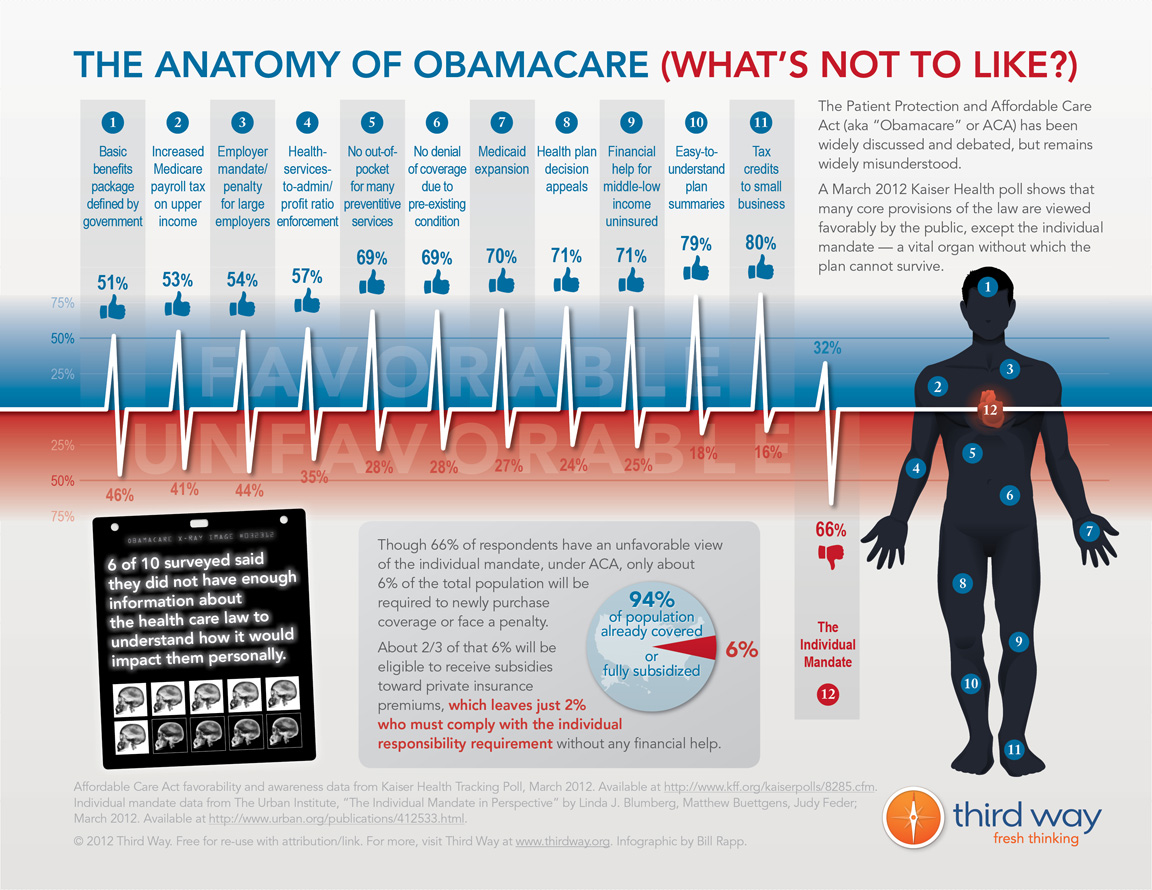
Obamacare (What's Not to Like?)

An infographic illustrating public attitudes toward the Patient Protection and Affordable Care Act (a.k.a. "Obamacare")


Click on illustration to see it full-sized.
Thanks to Third Way.

Has extensive coverage of comment about Ann Romney made her a symbol for women?

The news media insists on extending the flap about Hillary Rosen’s comment that Ann Romney can’t understand the economy and the struggles of most women because Ann has "never worked a day in her life.” On National Public Radio this morning, Cokie Roberts said that Rosen handed the Romney campaign a gift.

It’s this kind of nonsense that debases political elections. Rosen never should have made the comment but Rosen is a minor player at best and so it never should have become a major story. To think of it as a “gift to Romney” only makes sense if voters are judging the candidates on the off-hand remarks made by minor factotums in the candidate’s party or on the image and track record of their spouses. There is a lot of evidence to suggest that the media wants us to decide elections on these ridiculous factors, at least based on the coverage they give to these flaps as opposed to real discussions of the issues.

One interesting result of this much ado about nothing is that suddenly, Ann Romney has become a symbol of the stay-at-home mom, a dwindling group and one with twice the rate of poverty as moms who work. The latest study I could find (published in 2009) says that only 24% of mothers in families with children under 15 years of age don’t have jobs. And stay-at-home moms tend to be poorer: Just 5.1 %of working moms were below poverty level, while 12.3 % of stay-at-home moms fell into that category.

A few OpEdge readers have insisted in tweets that just because Ann Romney has servants and lived a life of ease does not mean she cannot understand or empathize with the average woman, struggling to make ends meet with or without a job.

Why don’t we begin by considering the question on a theoretical basis: Do you need to have experienced poverty (or racism, the stress of warfare, starvation or other emotional or physical pains) to understand intellectually or feel emotionally the various types of pain felt by those who have experienced these degradations? I used to think one could until I listened to women and African-Americans talking about their feelings of distrust, oppression, lack of confidence, need to prove oneself, or their depictions of barriers that I never saw, but which their fervor and accuracy told me were real. Yes, I understood and sympathized, but I still could not really know their lives and feel their exact feelings.

My experience, however, is anecdotal. I wouldn’t deny anyone else their belief in true empathy towards others with whom one doesn’t have much in common except basic humanity. I yield on the theory.

But let’s forget about the argument over whether or not you can feel another feller’s pain until you walk a mile in his shoes and cut to the chase: The fact that Ann Romney supports her husband’s policies, which cut programs that help poor and working families to fund continued low taxation rates for the wealthy, may not answer the theoretical question about empathy, but it does tell us how much empathy the Romneys, Ann and Mitt, have for the average woman. Zero.

Friday, April 13, 2012

Whether Ann Romney understands plight of average woman depends on if she has cook or personal assistant

By Marc Jampole

The news media immediately jumped on Democratic factotum Hillary Rosen when she accused Ann Romney, wife of the presumed Republican presidential nominee, of being unqualified to speak about the economy and the struggles of most women because Ann has ”never worked a day in her life.”

Many have taken the remark to be a slur on housewives who don’t work outside of the home. Suddenly the question of Ann Romney’s competence to speak about economic matters has morphed into an insult to stay-at-home moms. Even President Obama and Vice President Biden defended Ann Romney and by inference those women who, for whatever reason, do not hold a paying job.

But I think that everyone missed the point, because Rosen used the word “work” ambiguously. I don’t think Rosen meant that Ann Romney has never held down a job, but that she has literally never worked, at least not since marrying her robber-baron-turned-hypocrite hubby.

The crux of my argument (and what I think Rosen was really trying to say) depends on yes answers to at least several of the following questions.
  • Does Ann Romney, owner of several houses in various places, have a cook?
  • Does she have a housekeeper or cleaning service working more than 16 hours a week in one or more of her homes?
  • A driver?
  • A personal assistant?
  • Someone who routinely is paid to do the food shopping? A gardener or landscape service that works on any one of her properties more than a couple hours a week?

I’m guessing that the answer to all of these questions is yes.

Virtually all women in the United States work very hard. Household chores, shopping and most of the non-fun part of child-rearing fall on the shoulders of the stay-at-home housewife. Women who have jobs typically do more of the housework and childrearing tasks than their spouses, and usually it’s a lot more.

If empathy only comes from experience then Ann Romney definitely cannot relate to most women, be they stay-at-homers, careerists or those burdened with dual responsibilities. Her actually experience in the work force is next to nil and I’m reasonably confident that she has even less experience scrubbing floors and toilet bowls.

But we’re not being given the choice of voting for Ann Romney. It’s her husband not Ann who is running for office. It is true that we have had a run of accomplished first ladies with fine careers beginning with a slightly more famous Hillary and including librarian Laura Bush and attorney Michelle Obama. But we’ve also has housewives who have made perfectly fine first ladies, including the wonderful Betty Ford, who did work before her marriage to Gerry. There is no law that says a first lady has to have had a career or currently have one.

Here’s some advice to voters that often gets lost in the avalanche of non-news stories revolving around personalities, petty spats, verbal blunders and he-said-she saids: Don’t vote for either candidate because you like their spouse or dislike the other’s spouse. Vote for the candidate on the stands he (and maybe someday she) takes and his/her fast track record.

Wednesday, April 11, 2012

Does making making list of Top 10 growth cities indicate vitality or regressiveness?

By Marc Jampole

Earlier this week, CNN Money published a list of the 10 cities in the United States that achieved the greatest population growth from 2000 to 2010.

I’ll save you the trouble of clicking through all 10 web pages to see all the top-growing cities by telescoping it to a single quarter page:
  1. Charlotte, NC
  2. Raleigh, NC
  3. Cape Coral, FL
  4. Provo, UT
  5. Austin, TX
  6. Las Vegas, NV
  7. McAllen, TX
  8. Knoxville, TN
  9. Greenville, SC
  10. San Antonio, TX

The first thing we note is that all of these cities are in the South and Southwest, where much of U.S. population growth has been over the past two decades. That besides population growth, being in these states means that these cities have:

  • Lower wages for most people than in the North, Midwest and Far West
  • Anti-union laws for decades (except Nevada)
  • Less extensive social nets for the poor, young, ill and elderly.

Politically these cities are all located in red states, although North Carolina and Nevada are in the process of moving towards the Democrats. Eight of the 10 cities were part of the United States in 1861, and all 8 of these joined the oppressive slave-owning Confederate States of America.

Before giving right-wingers the chance to say that this growth demonstrates that the conservative mix of free market economics and authoritarian social values works, let me point out a few things:

  • These states all receive more in federal funds and benefits than they pay in all federal taxes. From the time of the Roman Republic through the medieval French fairs and until today, places thrive when governments give them money.
  • The low-wage jobs that attracted people to most of these places took away other jobs which paid higher wages in other parts of the country which have better social service networks and more public services places. (Note that government and universities played the major role in Austin and Raleigh, while Las Vegas is in sui generis, its own thing).
  • These cities are all new and in parts of the country that resisted urbanization longer than the Northeast and Midwest. Newer cities grow faster than mature cities. By definition, regions undergoing urbanization send more people to the cities than regions that have already been urbanized.

I like Raleigh a little, and I’m told that I would enjoy Austin as I do Eugene, Madison, Ithaca and other university towns. But on the whole, this list symbolizes what’s wrong with America today. As a group, these cities are centered on malls that look like each other filled with stores that look each other. These cities are built for cars and not for pedestrians or mass transit. The cities all look more like suburbs than traditional pedestrian-filled, urban mixed use spaces. The states containing these cities have higher rates of poverty and infant mortality and lower rates of people with health insurance. The wages are too low for many workers and less money is spent on providing social services, public education and public spaces than in other states.

And then there’s Las Vegas.

Growth is not always good. Cancer is also a growth.

Since World War II a slow-growing cancer has been poisoning the United States: the car-and mall-centric suburban consumer lifestyle; this wasteful lifestyle in which every celebration, emotional response or other manifestation of a mental state consists of buying something, usually by first getting in your car and driving somewhere. For the same standard of living, we use many times more energy and other natural resources than Western Europeans and the Japanese. These top 10 growth cities all symbolize the reason why the United States is the major contributor to global warming and resource shortages.

These cities represent the growth of sprawl. I would feel much better about the future of the country and the world if at least a few of America’s fastest growing cities were of the traditional type, with great mass transit, beautiful urban parks, lots of interesting local stores, major museums and other arts institutions, many walkers during all times of day and lots of public spaces.

Monday, April 9, 2012

Sunday NY Times loaded with articles that communicate hidden ideology to an unsuspecting public

By Marc Jampole

You ever wonder why Americans so easily follow our leaders into stupid wars or believe such nonsense as it’s uncool to do well in school or be smart?

It’s because hidden in the subtext of what we read, hear and see are a group of ideological assumptions that define how we live and think. The mass media spoon little messages into the hash of information and entertainment they feed us every day. These messages tell us what to believe or assume that we all believe the same thing:

The free market is best. Private sector solutions are always better than government solutions. All human relationships can be expressed and reduced to buying things. Society is best when we all act in our own self interest and not for the good of the whole. Learning and intellectualism are unappealing in both men and women. The United States is an exceptional country iwth a special role to lead the world.

We’re hammered with these false ideas day after day, and sometimes we don’t even know it.

Ideological subtext infects breaking news stories, but it drives feature news media, such as celebrity news, business, book reviews, entertainment and sports. Today’s New York Times shows two well-worn but contrasting ways to imbed ideology into feature articles.

In his weekly chess article, Dylan Loeb McClain reports on a Canadian TV show, “Endgame,” about a former world chess champion who never leaves his luxury hotel suite because he suffers from agoraphobia, which means he is afraid to be in wide-open spaces, crowds, and uncontrollable social situations such as shopping malls, airports, and on bridges.

Here we go again: a genius with severe emotional or relationship problems, unable to adjust, weird, unappealing, a nerd!!!

McClain, who has been doing a good job of telling the public about an exciting new generation of chess players like Hikaru Nakamura and Fabiano Caruana, did not have to do a story on this foreign TV show, which was never popular and was cancelled after one season. He chose to do the story, which means that he chose to perpetuate the myth that chess players are strange beasts.

Yes, Bobby Fischer, probably the greatest chess player of all time, was a nutcase. But Lasker, Euwe, Botvinnik, Karpov, Kasparov and most other world champs have been pretty normal people. I have hung around chess circles all my life and known hundreds of chess players. And some of them have been socially or emotionally off-balanced. Yet, it’s about the same as the percentage of nuts whom I have encountered among Scrabble players, poets, baseball and softball players, public relations professionals and boards of synagogues, social service agencies and other charitable organizations.

McClain’s completely nonjudgmental article focuses on how “Endgame” tries to get the chess right. But as a promoter of chess, McClain should care more about getting the image of chess right. Based on knowing hundreds of chess players, here’s the accurate image of the typical great chess player: a young man who does well in school, is a great athlete and has lots of friends of both sexes. That describes about 15 of the top 18-20 teenage chess players in the Pittsburgh area when my son was playing.

What we have then is one of the most important promoters of the game most associated with intelligence and intellectualism accepting as a given the premise that chess players are weird.

Now let’s turn to one of the cover stories of today's Book Review in which Jonathan Freedland proves once again that the Times book section is always interested in airing the full spectrum of opinion from right-of-center to right-of-center.

Freedland reviews new books on contemporary American geopolitics by Jimmy Carter’s national security advisor Zbigniew Brzezinski and policy wonk Robert Kagan. The premise of the review, as lifted in a quote made large in the wide outside margin of the page, is that “Brzezinski from the left and Kagan from the right agree that America should remain dominant.”

The first distortion is to label Brzezinski as a leftist. When he first appeared in the public imagination in the mid-70’s, it was as a centrist wanting to continue to normalize relations with China and the Soviet Union and interested in pursuing the business interests of large U.S. based multinational corporations. His views on Israel and the Middle East seem right of center to me. Kagan’s own views, as expressed in his new book, have been endorsed by President Obama, the avatar of right-of-center internationalism. Kagan may be to the right of Brzezinski but only by a hair or two.

After setting up the false dichotomy between left and right by portraying one center-rightist as a leftist and another as a rightist, Freedland expresses surprise to learn how much they agree with each other, especially on what matters.” Of course they agree with each other. They both belong in the Jack Kennedy-Scoop Jackson-Richard Nixon-Bill Clinton school of right-looking centrists on international matters.

This school, and American government officials and policy wonks in general, always feel the need to justify American imperial power plays abroad by placing the United States on the twin moral pedestals of pursuing democracy and free market capitalism. No wonder, then, that Kagan is able to write that “The two authors agree that it’s in everyone’s interest, not just America’s, for the United States to remain dominant.”

These two distinguished authors may say it and Kagan may repeat it, but it’s little more than a pretty fiction that our leaders have been telling us, and themselves, for decades. I’m not questioning the need for the United States to remain dominant for the benefit of U.S. multinationals and their political and academic factotums to thrive. And with economic and military dominance, it will be easier for these ruling elites to keep most of the rest of us satisfied with the crumbs from their tables.

What I object to is the false statement that U.S. dominance will be good for the rest of the world. It’s self-serving jingoism, and it’s based on the ideology of American exceptionalism. Like McClain’s covert (and perhaps unknowing) advocacy of anti-intellectualism, Freedland embeds the ideology of exceptionalism into his article by accepting it as an undeniable premise.

Friday, April 6, 2012

Payoff of fuel efficient cars depends on how you jigger the numbers

By Marc Jampole

Hybrids and other fuel efficient cars tend to cost more than comparable cars without the hybrid battery or other fuel-efficient technology. The natural question from the economic point of view is how long until the breakeven point? How many gallons of gasoline do I have to pump into the hybrid until the cost savings of getting more miles per gallon equals the increased cost to purchase the car?

Nick Bunkley proposed and answered the question for 18 fuel efficient cars in an article titled “Payoff for Efficient Cars Takes Years,” which started on the front page of yesterday’s New York Times business section and continued for almost a full page inside, including chart and photos.

From the Ford Fiesta SFE, which you must run for almost 27 years to break even with the traditional Fiesta to the Jetta TDI, which breaks even in 1.1 years over the traditional Jetta, it takes a while for the money savings to kick in from driving any fuel efficient car, no matter what the technology.

The problem is, Bunkley, like virtually every other economics writer, forgets about a lot of the costs. They only look at the costs that the owner of the car pays directly, and not at the indirect costs that all of society—including the owner—pay, or in this case don’t pay.

These social costs include:
  • The cost of increased respiratory and related illnesses because of the additional pollution.
  • The cost in damaged property from the greater increase in extreme weather events that global warming will bring.
  • Any costs to remediate the environmental damage directly resulting from car emissions e.g., cleaning buildings and streets.
  • The cost of military expenditures to protect gas supplies. Years ago an economist for CNG Pipeline named Mendel Yoho told me that if we added the additional cost of our military expenditures over those of Europe and added that to the price of gasoline that we would be paying about what Europeans pay for their gas.

With the great advances in digital technology and computational software, we can pretty much accurately assess each gallon of gas its share of these social costs. Adding social costs to the current price of gasoline would yield a “real” price of gasoline, which would be much higher, meaning that the payoff of switching to the more fuel efficient car would come more quickly.

We shouldn’t heap too much blame on Mr. Bunkley, who is merely taking a conventional approach.

In general, free-market economists and their popularizers frown upon the concept of social costs. They don’t like the idea of taxing companies and individuals for the social cost of a product or service, for several reasons. On the simplest level, any tax represents constraint on the market. The implication of a tax to assess social costs is that the government is intervening in the economy and society, either by using the money to address the social cost or by redistributing the tax to the population through lower other taxes.

This particular line of reasoning falls within the consistent position of Republicans for decades: no taxes and no redistribution of wealth (which in this case would be from polluters to everyone).

Did Bunkley think about including something about social costs saved by driving fuel-efficient cars and reject the idea? Probably not, because from health care to pollution controls to raising tuition to public universities, economics writings never focus on the cost to society, only to individuals.

And let‘s face it, an article with a list of 36 cars for sale is really about buying stuff. Bunkley is analyzing one of the criteria of purchase. I can imagine the car salesman saying, “The Civic Hybrid may have a cool color and great pick-up, but it’ll take you 12.1 years to break even, while it only takes you 4.4 years if you buy a Lexus HS 250h!”

At the end of the day, whatever one you buy, you’re buying a car, which is about the best thing anyone can do to support our suburbs-and-car-centered consumer society. Never mind that you will pollute the atmosphere to some degree, unless you’re running on solar or wind.

I’d like to see someone do an analysis, with and without social costs, of the breakeven point of building and riding mass transit.

Tuesday, April 3, 2012

A round of wedgies for Supreme Court, pro-gun extremists, Paul Ryan, Rick Santorum and others

Reading the news online this morning made me so angry that I wanted to hurt someone. Actually I wanted to hurt a bunch of people.

But since I’m a left-listing pacifist, I don’t really want to injure anyone or make them experience extreme pain. Maybe just make them feel a little discomfort and a whole lot of shame for what they’ve done.

In other words, I want to give them an OpEdgie Wedgie.

For my readers who may not be familiar with American youth culture or are not native speakers of the American version of English: Merriam-Webster’s defines wedgie as “the condition of having one's clothing wedged between the buttocks usually from having one’s pants or underpants yanked up from behind as a prank.”

Perusing the news about the latest mass murder on a college campus—the killing of 7 at tiny Oikos University in Oakland, California, makes me want to give an OpEdgie Wedgie to anyone who has ever voted for or advocated allowing people other than law enforcement officers to carry guns or bullets on college campuses.

And I’d like to give an OpEdgie Wedgie to Supreme Court Justices Roberts, Scalia, Thomas, Alito and Kennedy for voting that officials may strip-search people arrested for any offense, however minor, before admitting them to jails even if the officials have no reason to suspect the presence of contraband. My wild-running imagination wants these particular operations to leave an imprint of a swastika or hammer & sickle.

And let’s give an OpEdgie Wedgie to whoever in Obama’s Drug Enforcement Administration was involved in the decision to raid Oaksterdam University, a private school that trains people how to grow, package, retail, cook with and sell medical marijuana. Oaksterdam U. is located in California, where use of medical marijuana is legal. The raid represents the sheer stupidity of our drug laws as they apply to a relatively harmless substance that many people use to alleviate pain, subdue anxiety, counteract the nausea of chemotherapy or fight the effects of glaucoma and multiple sclerosis.

Republican presidential candidate Rick Santorum deserves an OpEdgie Wedgie every day, just for being Rick Santorum. He really deserves three or four OpEdgie Wedgies a day, one for his constant use of racial code phrases, one for implying that African-Americans are the primary recipients of government assistance to the poor, one for wanting to inflict his moral values and religious beliefs on the rest of America and one for pretending to advocate for the working class while all along working for the ultra-wealthy.

Mitt Romney deserves a daily OpEdgie Wedgie for hypocrisy and a thirst for power that will make him say or do anything.

And while we’re at it, let’s give a daily dose of the OpEdgie Wedgie to Paul Ryan for saying his budget plan will end the federal deficit by closing tax loopholes, but never telling us which loopholes he will close. For details, see Paul Krugman’s article earlier this week titled "Pink Slime Economics."

Speaking of pink slime, let’s give a pink OpEdgie Wedgie to the manufacturers of this concoction of ground-up meat parts for claiming pink slime is all beef, forgetting to mention that the beef to which they refer includes connective tissue, cartilage and fat. They also forget that it’s not the beef we care about, but the fact that it’s been marinated in ammonia.

I have never gotten or given a wedgie, so until this moment, I never realized what a great release of pent-up aggression one can experience from pulling up someone else’s shorts, even if done only in the head. I feel much better. Relaxed, almost glowing.

All I have to do now is shut the news out and I think I’ll be okay.

Sunday, April 1, 2012

How is the money race going?


(Click to make the images bigger. Graphics by Kevin Kreneck.)